- dev.png)

Insights from our peer-reviewed journal | Compiled by Megan Skrip - 17 September 2026
A new simulation shows battery swapping beats fast charging for underground mining fleets by boosting productivity and prolonging battery life
Replacing diesel-powered mining vehicles with battery-powered equivalents can considerably reduce energy consumption and cost (see "Electric energy savings," Research in Brief, June/July 2026). But which battery-use strategy is more productive or efficient: fast charging batteries that remain in trucks or swapping depleted batteries with full ones?
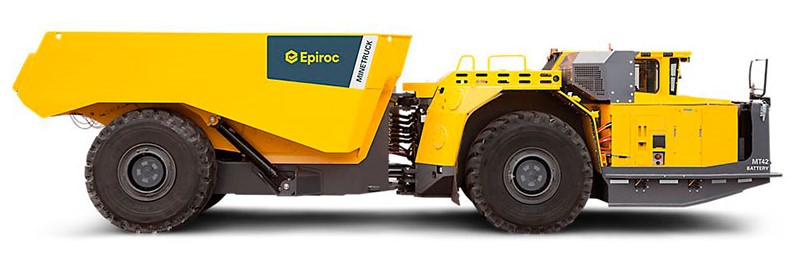
Above: Side view of Epiroc Minetruck MT42 Battery, a typical low-profile underground mine truck and the vehicle simulated in this study. Courtesy of Epiroc
To compare the two strategies, the research simulated the load-haul cycle operations—including queuing, logistics, and blasting and clearance shutdowns—of an eight-truck underground mining fleet using the Epiroc Minetruck MT42 Battery. Scenarios varied by battery pack size, recharge power level, battery-to-truck ratio (for swapping cases) and route length (with a 15 per cent uphill grade for the loaded truck). The number of delivered ore loads and battery health were tracked across time.
Overall, swapping emerged as the better strategy.

Courtesy of Ken Darcovich
“From this simulation study, battery swapping generally works better than fast charging for underground electric mine trucks,” said Ken Darcovich, lead author of the study and a researcher with the National Research Council Canada. “It keeps trucks moving more, uses less energy and helps batteries last longer, especially when there are about two to three batteries available per truck—higher battery-to-truck ratios—to avoid [trucks] waiting [for a charged battery].”
In the simulations, battery swapping typically resulted in more ore loads delivered per truck per year than fast charging. Larger battery packs and lower charging power also extended battery lifetimes.
“Importantly, the study’s value is that it provides one of the first detailed, fleet-level comparisons of these options, helping mines understand how charging strategy, battery size and battery-to-truck ratios affect real operations,” said Darcovich.
The CIM Journal is a quarterly digital publication for peer-reviewed technical papers available to all CIM National Members as a membership benefit and to non-members for a fee. Papers cover all facets of the mining and minerals industry, including geology, mining, processing, metallurgy, materials, maintenance, environmental protection and reclamation, mineral economics, project management, health and safety, risk management, research and development, operations, and regulatory practices and issues.
Since 2020, the CIM Journal has been published by Taylor & Francis. The editorial process remains the same and CIM National Members continue to have free access to the journal. New papers, in addition to the archives, are now hosted on the CIM Journal site at Taylor & Francis. Papers published prior to 2020 can be found on the CIM Technical Paper Library or on OneMine.
To ensure you can access this CIM Member benefit, please ensure you are logged in to your CIM account.