- dev.png)

Insights from our peer-reviewed journal | Compiled by Megan Skrip - 29 June 2026
Going electric cuts energy consumption by up to nearly 90% and slashes fueling costs in underground mines
According to this study, replacing diesel-powered vehicles with battery-powered equivalents in underground mines can reduce energy consumption considerably more than previously predicted, leading to cost savings.
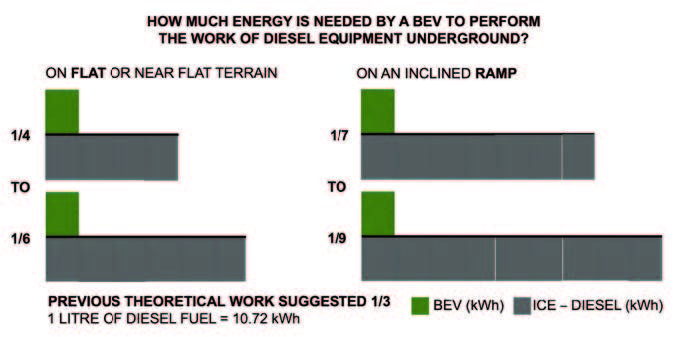
Above: Field trials in underground mines in Canada and the European Union showed that battery electric vehicles (BEVs) consume considerably less energy than comparable vehicles with a diesel internal combustion engine, particularly on inclines, where BEVs can regain energy through regenerative braking. Courtesy of Enrique Acuña-Duhart
Across four field trials in the European Union (EU) and Canada, researchers compared the energy consumption of battery electric vehicles (BEVs) and their diesel counterparts (mainly load-haul-dump vehicles) on horizontal or inclined test tracks, accounting for distance travelled and load carried.
They found that “[BEV] underground mining equipment consumes one-quarter to one-sixth of the energy used by the equivalent diesel machines when operating in flat or near-flat terrain, and that it can go down to one-seventh to one-ninth on an inclined ramp,” said study co-author Enrique Acuña-Duhart, a senior energy efficiency specialist with Natural Resources Canada’s CanmetMINING. “These ratios are less than the hypothetical ratio of 1:3 stated in many references,” which consider only motor efficiencies, not other powertrain components or operating conditions. Unlike diesel vehicles, BEVs can regain energy through regenerative braking to recharge the battery, especially on downhill slopes.
The researchers also found that lower energy consumption meant substantial cost savings, with the potential for lower greenhouse gas emissions as well; during the Manitoba field trial in June 2023, when electricity cost $0.1279/kWh and diesel fuel $1.563/L, the cost of powering the tested BEV was over four times less than that for the same make and model of diesel vehicle.
“This work’s energy metrics,” said Acuña-Duhart, “are a key input for the mining industry as part of the ongoing Natural Resources Canada’s CanmetMINING branch and the EU Commission efforts to achieve the 2050 net-zero greenhouse gas emissions target.”
The CIM Journal is a quarterly digital publication for peer-reviewed technical papers available to all CIM National Members as a membership benefit and to non-members for a fee. Papers cover all facets of the mining and minerals industry, including geology, mining, processing, metallurgy, materials, maintenance, environmental protection and reclamation, mineral economics, project management, health and safety, risk management, research and development, operations, and regulatory practices and issues.
Since 2020, the CIM Journal has been published by Taylor & Francis. The editorial process remains the same and CIM National Members continue to have free access to the journal. New papers, in addition to the archives, are now hosted on the CIM Journal site at Taylor & Francis. Papers published prior to 2020 can be found on the CIM Technical Paper Library or on OneMine.
To ensure you can access this CIM Member benefit, please ensure you are logged in to your CIM account.