- dev.png)

CIM Staff - 25 September 2026
From consultation to genuine partnership
Each September 30, Canadians observe the National Day for Truth and Reconciliation: a day dedicated to honouring residential school survivors, remembering the children who never returned home, and answering the Truth and Reconciliation Commission’s Call to Action 80.
Because mining is fundamentally tied to the land, the resource sector bears a direct responsibility to confront the lasting impacts of historical land-use policies on Indigenous peoples. Moving toward true reconciliation requires co-development, shared economic ownership, and Indigenous-led stewardship from early exploration through post-closure.
Strength in unity: Setting a new standard for impact benefit agreements
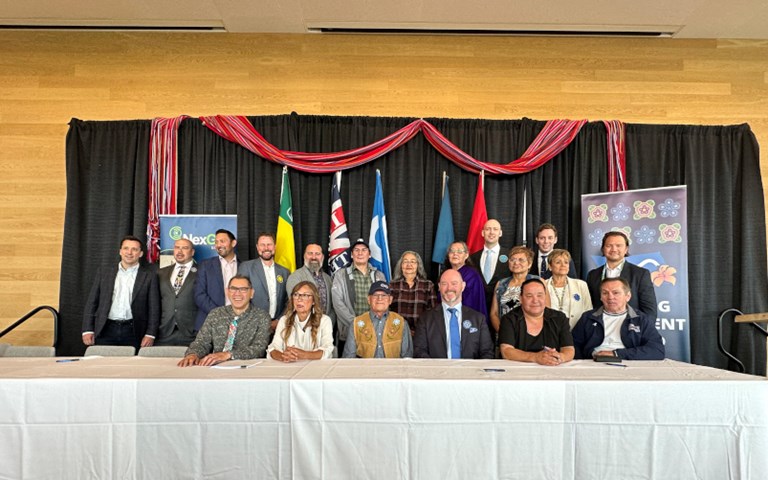
A tangible model of collaboration is unfolding in northwestern Saskatchewan with the Rook I uranium project. In an agreement hailed by Métis Nation–Saskatchewan (MN-S) as the largest impact benefit agreement (IBA) of its kind in Canada by geographic scope and community representation, Northern Region II (NR II) negotiated alongside MN-S to secure lasting economic and environmental authority.
Rather than negotiating in silos, all seven community-level locals within NR II adopted a unified “One Voice” model, ensuring that decision-making power remained squarely in local hands. The resulting agreement with NexGen Energy establishes continuous engagement across the mine’s entire life cycle—including reclamation—while securing vital local employment, training, business contracts, and funding for regional infrastructure such as long-term care and wellness facilities. By anchoring the partnership in mutual respect and proactive planning years before construction, the Rook I agreement demonstrates how Indigenous governance can direct major resource development to foster generational prosperity.
Beyond a single day: Embedding Indigenous leadership throughout the mining life cycle
Advancing reconciliation in the resource sector requires ongoing listening, learning, and relationship-building that cannot be confined to a single day on the calendar. Jenny-Lou Campbell, Executive Director of the Indigenous Centre of Excellence for Mineral Development (ICEMD) and an Anishinaabe-Kwe member of Serpent River First Nation, reinforces that long-term industry sustainability depends on embedding Indigenous perspectives across the entire mineral development life cycle.
Raised in Northern Ontario mining communities and educated in natural and environmental sciences, Campbell transitioned from early skepticism about the sector's environmental footprints to advocating for responsible development from within technical, operational, and executive roles. Her insights spotlight key pillars for meaningful engagement:
- Rooted in stewardship: Guided by the Seven Grandfather Teachings (respect, humility, honesty, love, bravery, wisdom, and truth), she emphasizes that mineral development must be grounded in accountability and the protection of connected lands and waters.
- Life-cycle involvement: Indigenous voices and knowledge systems must be actively included at every phase—from initial prospecting and exploration to operations, mine closure, and post-closure reclamation.
- Youth representation and mentorship: Building sustainable pathways for Indigenous youth in STEM, mining, and skilled trades requires strong mentorship, storytelling, and visible representation to show that Indigenous identity and cultural knowledge are fundamental assets.

Looking forward
“When thinking about mining and reconciliation, they are inherently inseparable. Both are land-based relationships.
“We know that mining impacts land and can also deliver benefits to communities. At the same time, Indigenous peoples have been stewards of that land over time. With that understanding, we must work in unison, in partnership, because building relationships with Indigenous people is not an optional thing to do. It’s essential to understand what it looks like to have healthy communities, to mitigate negative impacts, and to think about how our mining activities can be carried out responsibly so that future generations can also be as healthy as possible.”
- Nipuni Amaratunga, Advisor, Indigenous relations, Teck

As the Canadian mining industry positions itself to deliver the critical resources required for global decarbonization, projects that place Indigenous self-determination, stewardship, and shared value at the core of their design will define the future of responsible resource development.
Read more: CIM Magazine stories on Indigenous voices, knowledge, and innovation