- dev.png)

CIM Staff - 01 August 2026
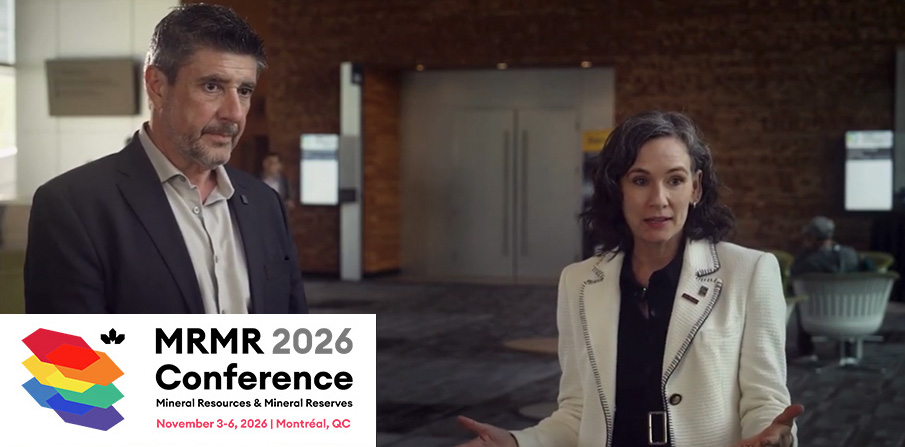
Mineral Resources and Mineral Reserves Conference chair Rodrigo Marinho and vice conference chair Lucy Potter were interviewed during CIM CONNECT 2026 in May about the strategic vision behind the conference's single-session format.
The MRMR Conference brings exploration, finance and sustainability under one roof to shape the next century of responsible development
In an industry where technical precision is paramount, the greatest value is often unlocked not within a single discipline, but at the intersections where many disciplines meet. While geologists, engineers and finance professionals have historically operated in distinct silos, the realities of modern project development demand a unified front.
On November 3-6, the Mineral Resources and Mineral Reserves Conference tackles this challenge head-on under the theme, "The Integrated Lens: Collaboration for Responsible Mineral Development." By collapsing traditional boundaries, the event brings the entire mining lifecycle—from baseline environmental studies to final mine closure—into a single, shared conversation.
Conference chair Rodrigo Marinho and vice conference chair Lucy Potter were interviewed during CIM CONNECT 2026 in May about the strategic vision behind the conference's single-session format. They explain how physical proximity sparks multidisciplinary breakthroughs, the ongoing evolution of CIM’s globally recognized best practice guidelines, and the legacy they hope to leave for the industry professionals of 2126.
CIM: The MRMR Conference theme this year is 'The Integrated Lens: Collaboration for Responsible Mineral Development.' Why was it important for the Mineral Resources, Mineral Reserves Society of CIM to bring the mining lifecycle—from exploration to reporting—into a single focused event?
Potter: The planning committee for the MRMR Conference felt that it would be reflective of reality, in that we don't work in silos. It's really important that although mineral resources and reserves are technical outputs, they rely on inputs from a very broad range along the mining value cycle—from social, environmental and baseline studies all the way through to closure and remediation. We wanted the conference to reflect that end-to-end industry portrait.
Marinho: Indeed, the exploration geologist can work with you, depending on the ESG tasks that we can complete. From there, all the way through geological modeling and, as Lucy said, to mine closure—passing through mineral reserves estimates and processing definition in terms of workflows and worksheets—that's all going together in the same cycle. That's the reason that we're putting together this concept of exploration to mine closure in only one event.
CIM: We often hear that value is created at the intersection between mineral resources and mineral reserves. How is this year's conference designed to get geologists, engineers and investors talking to each other instead of working in silos?
Potter: It's physically constrained, or set up, in a way that we get engineers, geologists and finance professionals in the same room. We got really good feedback in 2020 from people who liked that single-session, single-discussion format where you could see things from the perspective of other professionals and not just work in your own silo. It's allowing us to now curate a program that allows people to see perspectives from those other disciplines.
Marinho: In addition to that, we do have debates and panel discussions where we are going to have representatives of different disciplines. It's going to be in one big room for people with different opinions and knowledge to sit together, bring new ideas, and share those ideas as well.
CIM: As we celebrate 100 years of the CIM CONNECT Expo, what is the legacy you want to leave for the miners of 2126?
Potter: What a great moment to look back on our professional legacy. If we can speak to the people of 2126, I would like them to think that we acted responsibly and that we thought about the future long-term in some of the decisions that we're taking now, so that we're not seen as having a shortsighted vision—that we really planned for that future.
Marinho: And we, of course, during this conference, wanted to foment exactly this culture: that we all need to learn from everyone, and we cannot assume that every discipline is going to work independently. For us, the future is next door, and we are starting with a very good first step. I'm pretty sure in 100 years they will confirm that we had a good start.
Potter: And I don't know about you, Rodrigo, but the further along I get in my career, the more I realize that I don't know about other disciplines. Being in a room with those other people—people from finance, people from sustainability—helps me understand what my role is better and, in general, what the whole ecosystem is like.
Marinho: And we learn from every session that we go through. New elements that are important—not only environmentally in our process, but financially. We are learning every time that we actually have the chance to discuss and learn.
CIM: How does CIM help us translate mining into a story of global responsibility?
Potter: Well, mining is global. Ore bodies are not defined by geographic boundaries, so we have to look at them in a holistic way. Canada is a great place that defines the way we work, our values, and the technical know-how that we've developed over hundreds of years. It allows us to share that knowledge and share that experience across these boundaries for the benefit of all.
Marinho: All the companies working across the globe have some sort of standard to follow, and the majority of them follow CIM best practice guidelines. The practices that we set up as the standard here—which are very high standards for mining—are followed in very many different countries where we have our projects and operations.
Potter: And [the NI 43-101 is] actually going through a revision at the moment. It's really important that we hear from different practitioners across the industry to work together and make sure that the regulations that we follow are appropriate based on the changing context.