- dev.png)

CIM Staff - 07 August 2026
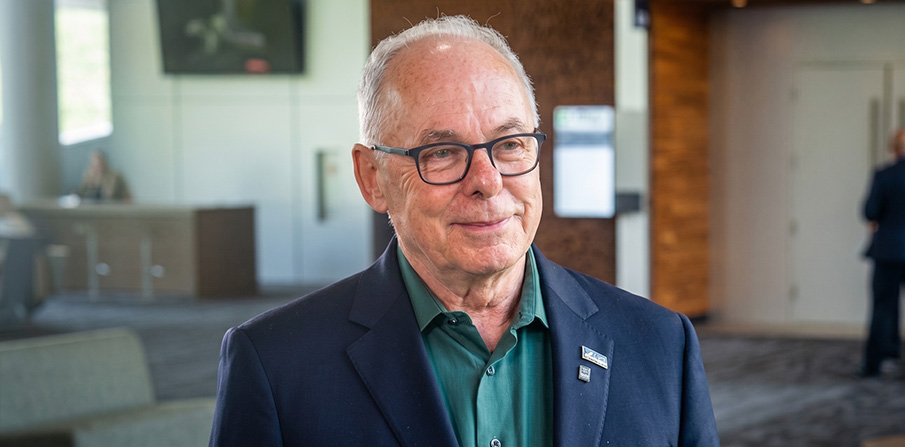
CIM President John Rhind on Canada’s hidden competitive advantages, building strategic relationships, and preparing the workforce for a sustainable future
At CIM CONNECT, the energy surrounding the future of Canadian mining was unmistakably upbeat, driven not just by rapid growth, but by an unwavering commitment to sustainable operations. As the world looks to Canada to supply the critical minerals needed for a global transition, the industry faces pivotal questions about supply chain advantages, talent development, and global leadership.
In this conversation, CIM President John Rhind reflects on the key strengths that position Canada on the world stage, from its strategic geography to a newfound alignment between academia, government, and the public. He shares practical wisdom for early-career professionals, outlines CIM’s role in exporting sustainable best practices internationally, and details his core priorities for his presidency—including a brand-new education strategy designed to equip both graduates and mid-career professionals for the tech-driven future of mining.
CIM: What is the difference in the conversations happening this year at CIM CONNECT?
Rhind: Six months to a year ago, we were thinking that we might see growth in the industry. But this year, we clearly see growth in front of us. The change in the conversation from years ago is that when you're facing growth today, people are talking about growth with sustainability.
I think that's really important because if you don't think about how to grow sustainably, guess what? You're not going to be growing for very long. So, yeah, I would say we're very upbeat. We're really, "Let's get going, let's get growing," but we're having conversations around how do we grow and grow in a sustainable way, which I think is the right way to go.
CIM: When you look at the junior members on your team today, what is the one hard-won lesson you're trying to save them from learning the painful way?
Rhind: I can tell you one thing I feel really, really strongly about, because I was not good at it, and in fact, I still have to remind myself that this is important: It is so important to meet your friends before you need them.
What I mean by that is if you're coming out of university or trade school, and you're starting at a company or any organization, it is good practice to start meeting other people and developing relationships with them. If you have to collaborate with somebody or ask somebody for help, it's much easier to do that if you already have a pre-existing relationship.
Often times, we're dealing with major problems, and when we deal with a major problem, the only way to solve a problem is to have help. Asking people for that help is much easier when you know them and they know you. So, make your friends before you need them.
CIM: The world is looking to Canada for critical minerals. From your perspective, what is the one competitive advantage we have that we aren't talking about enough?
Rhind: What most Canadians don't know about Canada is where we're located relative to the major markets across the globe. We're the closest shipping country from Asia. Many people don't think about that from the Pacific coast, and when you think about the Atlantic coast, we're very, very close to Europe.
So, we are actually well-located from a supply chain perspective to the major customers that we have around the world. That's one advantage that we have.
The other advantage that we have is that the geological potential of our country is amazing. I think most people know that now, but I think the advantage that we have today is that the public, politicians, and academia all understand how important developing our resources is to meet the needs of the world.
CIM: As we celebrate 100 years of the CIM Expo, what is the legacy you want your current project or presidency to leave for the miners of 2126?
Rhind: I'm really excited about taking on the role of President this year, and there's a couple of things that I am really interested in making happen.
Before I say that, I really like the journey CIM has been on for the last few years. I think we are becoming more relevant, and our stakeholders are showing up and participating in the conferences that we do hold.
There's two things that I think are important:
- Continue to become more relevant to our stakeholders: We are targeting to have more mining operators at our conferences because, at the end of the day, it's those operators who implement the technologies, processes, and systems that make the world go round. I really want to make sure that we're consistently relevant for the operators.
- Growing the workforce: As a country, we're going to grow the mining sector, and we need to make sure that we have the people to meet the demand going forward. We're going to be embarking on an education strategy working group that is all about attracting, developing, and ensuring that people coming out of schools—whether universities or trade schools—have the skills they need to hit the ground running. As we continue to invest in things like decarbonization, electrification, and digitization, we need to help mid-career professionals learn what those new technologies are so they can implement them in the field.
CIM: How does CIM help us translate mining into a story of global responsibility?
Rhind: CIM brings people together to collaborate on best practices, systems, and even technologies. We do that in a way that meets the need for growth and does it in a sustainable way.
What the CIM does then is share that information through our conferences, webinars, and written material. It doesn't just land in Canada; it's actually international in scope. That enables us to be leaders in these systems, processes, and technologies done in a sustainable way across the globe.
CIM: What is the mood of the industry and where do you think we are headed?
Rhind: The mood is upbeat. The mood is that we're going to grow, and we're going to grow rapidly. There is a lot of optimism in the industry relative to a year ago.
What I like about the conversation is, "Let's grow, and we'll grow rapidly, but let's grow sustainably." I'm hearing that at this conference as well, which is quite unique. Given my history over the last few decades—where when growth is in the window, people forget to talk about sustainability at the same time—I don't detect that at all here. I detect growth with sustainable operations.