- dev.png)

CIM Staff - 16 October 2026
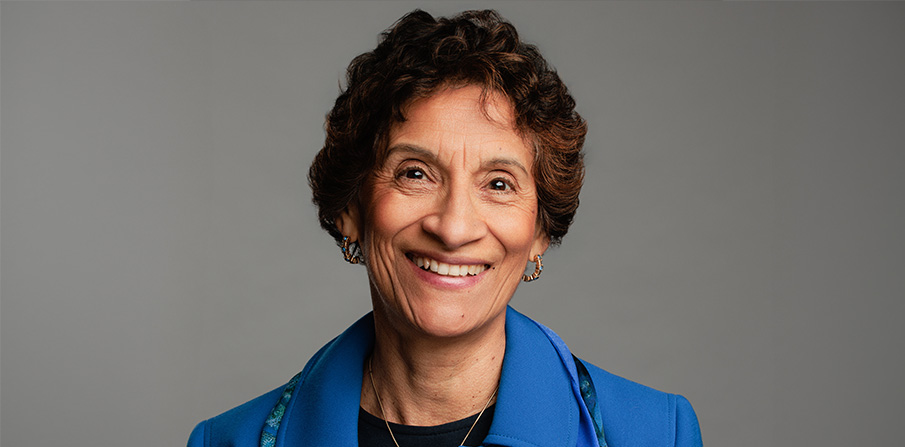
A conversation with Doris Hiam-Galvez
CIM Selwyn Blaylock Award recipient Doris Hiam-Galvez on breaking operational silos, transitioning to a knowledge economy, and leaving behind a thriving legacy
Can mining evolve from an industry defined by extraction into a catalyst for regional prosperity? For Doris Hiam-Galvez, recipient of the CIM Selwyn Blaylock Canadian Mining Excellence Award, the answer lies in dismantling traditional silos, both beneath the surface and across communities. In this conversation, Hiam-Galvez reflects on the technological shifts redefining mineral extraction, the power of experiential learning through the iScientist program, and why true industry leadership means leaving behind resilient, self-sustaining economies long after the mine has closed.
CIM: There is a lot of noise about the future of mining. Based on your work reducing environmental footprints on billion-dollar projects, what is the one quiet shift you’re seeing right now that you think will have the biggest impact in a decade?
Hiam-Galvez: I believe it's the deep knowledge of the ore body. We get excited with our silos—geology, mining, processing—but we don't understand that's just one system. What the client cares about is how quickly we get to the rock face and how cheaply we can get to market. We all should love geology—the miners, the processing engineers, and all—because once we understand it well, we can mine just the value, extract just the value, not blow the whole thing.
We can design a process to extract maximum value from the ore body so we don't have to create so much waste, because most of the activity in mining is handling waste. The best yet is in-situ recovery, so the rock becomes a reactor in its place. We extract the value from there and leach right on site.
The impact is not just minimal impact, but positive impact. This technology is used for certain ore bodies, but it's advancing enough to perhaps do harder sulfides and new ways to process. The key is falling in love with the ore body through knowledge.
CIM: Through your work with the iScientist program, you are bridging the gap between mining and schools. When you look at the next generation of scientists here today, what is the one skill or mindset they have that our generation didn't?
Hiam-Galvez: The next generation is a lot more aware that sustainability and environmental health is a given. It's not in a silo anymore. In the past, we had to learn the hard way that it's important.
With the iScientist program we deployed around Canada with CIM and mining funding, it was an incredible experience because we introduced project-based learning in the schools. We started in a school in the Northwest Territories, thanks to Anglo (American), who put the kids together. This was in the summer. The kids couldn't sleep at night; the sun never set, so they were tired. It was virtual, so when we started, they were falling asleep, and we thought we had no chance. But as we initiated the project—first to lose the fear of learning, lose the fear of knowing the answer, formulate their own questions, formulate their own hypotheses—they started taking shifts: "I will do this. I will do that." They got into indigenous, learn-from-the-land, experiential learning.
When we finished the experience, they were fully engaged. They worked at the level of graduate school—these were middle school, high school students. They prepared elaborate posters and described them with all their passion. One of them said, "I want to take the curiosity I learned here and become a scientist." Another said, "I want to take the courage I learned here, be a leader, and take my people to a better place, to a better world." The purpose of iScientist is to create the love of learning and keep that curiosity alive.
CIM: From your perspective as a global leader, how do we move from being a resource-rich nation to a technology-leading nation, specifically one that leads in the science of sustainable prosperity, in the eyes of global investors?
Hiam-Galvez: Canada is a resource-rich region, and we are pioneers on many fronts. We have a history and a lot of success from the past, but we have an extractive economy. We are miners, we do oil, we do forestry, but all of that wealth will end at some point. Because we have so much wealth in those resources, we became a bit complacent, so we end up being technology buyers. Although in the past we developed many new technologies and processes, we lost a little bit of our shine. We have a lot of small companies doing equipment, but we are turning into technology purchasers. Our people are highly educated, we are bright, we have everything. We have to build a knowledge economy to really transition from an extractive economy to a knowledge economy.
Designing Sustainable Prosperity is for mining to come into a place as an enabler of something better, to diversify the economy, to be a catalyst and integrate. Every region has something specific they can hone in on, create the IP, become the center of excellence for one or two things, and export that knowledge to the world. This is different for each region. It's not just adopting the hot trend—just build a hydrogen plant or a battery plant, and then where is the market?—but rather a system solution for each region, ideally suited to take the region into the future to build a resilient economy.
CIM: Now that your work is being held up as a benchmark for the Institute through the Selwyn Blaylock Award, what is the one old way of doing things that you hope your DSP (Designing Sustainable Prosperity) framework finally helps the industry move past?
Hiam-Galvez: Nobody wants mining in their backyard because we have done harm, and they are not just going to forget about it. No matter how loud we say it, they are not just going to change our image. To change our image, we have to do different things rather than doing more of the same.
The world desperately needs minerals for society to continue, for data centers, for electrifying the world. This is our chance during the boom of mining to create something greater, so that our image changes, not just consuming energy from the system, but adding energy into the system and becoming a catalyst for something greater, to create a resilient economy where people, planet, and prosperity exist in balance.
That's where mining becomes an enabler of regional prosperity, trust is restored, and true collaboration happens. It's for us to do something greater than just mining: become a good guest, become part of the community, and together create something that is lasting for everyone: an economy that benefits everyone.
CIM: Your core philosophy is that 'Mining will ultimately be judged by the future it enables.' As we celebrate 100 years of the Expo, what is the specific legacy you want your current work in sustainable prosperity to leave for the miners of 2126?
Hiam-Galvez: Our legacy for 100 years from now is that mining has left thriving, resilient ecosystems in each mining region we explore. Not just miminal harm, but positive impact, and resilient, thriving economies for generations to come.