- dev.png)

Maria Olaguera and Michele Beacom - 06 October 2026
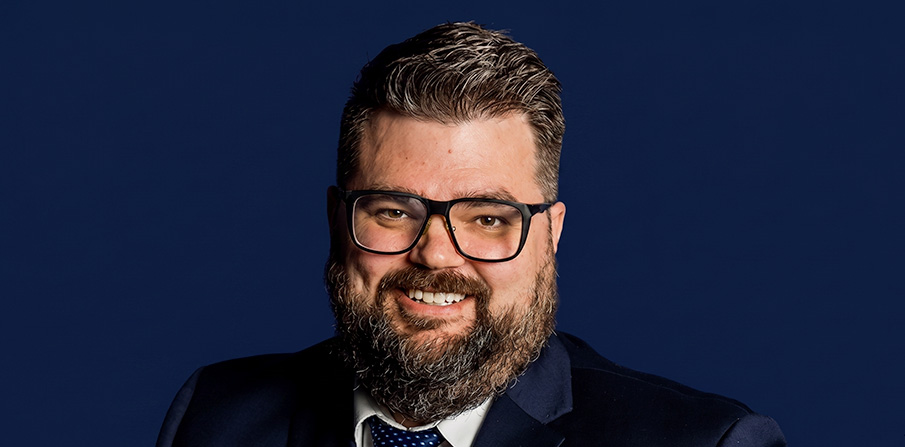
Meet Stephen Gravel
As manager of the Centre for Smart Mining (CSM), a specialized applied research hub at Cambrian College in Sudbury, Ontario, that helps mining and technology companies test, derisk and adopt 21st-century innovations, Stephen Gravel is a busy guy. He has been with CSM since its inception in 2019, and has led several initiatives to mature the centre, from securing financing to initiating certification programs.
Gravel was instrumental in fundraising to create the Vale Electric Vehicle Lab, a 5,600-square-foot applied research facility at Cambrian that opened in September 2024 and focuses on developing, testing and advancing heavy-duty electric and battery-powered vehicle technology for the mining sector. He was also responsible for securing a $1 million grant from Natural Resources Canada in June this year for a project focused on converting diesel powertrains to fully electric systems on equipment of medium-sized suppliers, with the goal of making the transition to zero emissions more accessible for smaller OEMs and service providers across the sector. In addition, Gravel launched a transformative upskilling certification program in industrial battery-electric vehicle (BEV) maintenance to train heavy-duty mechanics employed at local businesses that are in the process of electrifying their mobile assets.
Outside of his projects at Cambrian, he also co-chairs Modern Mining and Technology Sudbury, which focuses on educating and enlightening youth about the broad range of mining-related careers in the area and he is part of the organizing committee for the annual Global Mining Guidelines Group Sudbury Forum, which contributes to the advancement of global best practices in responsible mining. In his spare time, he co-hosts the podcast The Unlikely Innovators.
CIM was lucky to grab him for a few minutes at CIM CONNECT 2026 in May to talk about the work he is doing to accelerate technology development and adoption in the mining sector and to help build a talent pipeline.
CIM: Since its inception, CSM has engaged nearly 200 companies and launched over 70 products in the sector. What is the legacy you hope these prototypes and research partnerships will leave for the Canadian mining industry?
Gravel: I think the legacy we want to leave with the centre and the types of projects we work on is really about safety: did we make mining in Canada safer and more productive?
CIM: You have created over 770 student research positions to develop Canada’s talent pipeline. What skills do you recommend students acquire to give them an advantage in the modern mining workforce?
Gravel: One of the things we really want to show is that mining has always been innovative, and mining will continue to be innovative. When we think about skills for the students who come through CSM, what we focus on is no matter what discipline you’re in, you have to start thinking about digital skills. If you’re an electrician, a heavy-duty equipment mechanic or even a carpenter, you need to have digital skills to be competitive in the new workforce.
CIM: You’ve been a driving force behind the Vale Electric Vehicle Lab and upskilling heavy-duty mechanics for BEV maintenance. What shift in mine electrification do you think will have the biggest impact on operational excellence over the next decade?
Gravel: Electric drivetrains. The biggest evolution in underground electrification that will have an impact on operational excellence is how electric drivetrains are amenable to automation. It’s much easier to do automation if you’re starting with electric vehicles rather than diesel equipment. It really facilitates downstream automation; autonomous driving and driver assist are made easier using electric drivetrains.
CIM: You joined CIM’s Innovation and Technology Society to facilitate connections across the mining technology ecosystem. What technical insight can be gained from these cross-disciplinary partnerships that could never be found in a traditional textbook?
Gravel: Cross-disciplinary teams are so important. You have to think about not only the job that you train for, but all the other jobs that you integrate with. I think from the work we’ve done at the centre, you really notice that the barricades between disciplines have started to dissolve, and you’re thinking of a whole-of-mine approach.
CIM: With over 148 podcast episodes of The Unlikely Innovators, you’ve become a master of mining storytelling. What is the one thing you share to help people see how their daily life depends on mining?
Gravel: I think we can all agree that as we decarbonize and as technology continues to evolve, we need those minerals that are in the ground. As a podcaster, when I’m talking to people from outside the sector about why they should care about mining, I do it very simply—what I tell them is “mining will save the world.”