- dev.png)

08 June 2026
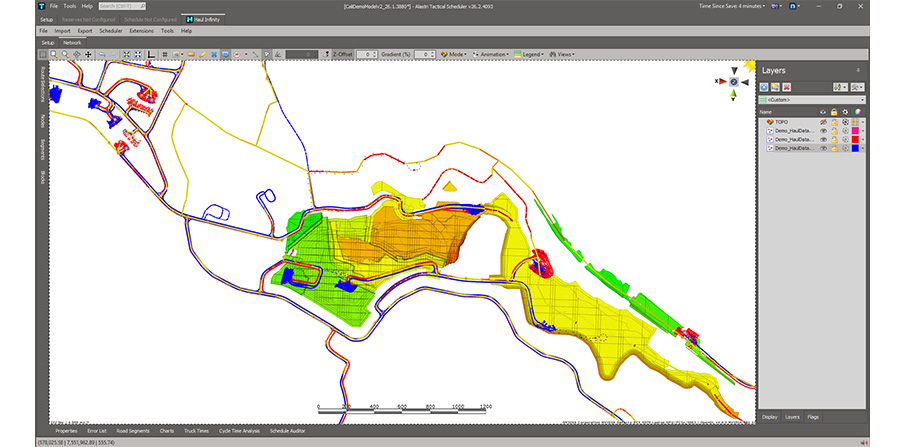
Above: Fleet management system event data layered over the haul network in Micromine Alastri highlights gaps between planned routes and real-world performance.
Industry Partner Spotlight
This story was provided by Micromine, a CIM Industry Partner, and appears in the May 2026 issue of CIM Magazine (view it in flip format here).
A faster path from haulage data to decisions
Haulage calibration offers a more direct way to bring operational data into planning

Open-pit mines generate enormous volumes of haulage data, but many operators still struggle to isolate what matters most and use it to improve planning. That disconnect is expensive. Haulage is one of the largest cost drivers in an operation, and when schedules rely on assumptions that do not reflect how trucks are actually performing on site, it can result in wrong cycle times, understated fleet requirements and avoidable cost pressures.
That is why haulage calibration deserves more attention. While simulation remains an important tool, calibration offers a more direct way to bring real operating data into the model.
Where haulage models start to drift
Haulage models are built using sound engineering logic: equipment specifications and physics. The issue is not that these models are wrong in principle; it is that real haulage performance is shaped by more than theory alone. Traffic, congestion, road conditions, operator behaviour and the way trucks actually move through active mining areas can all pull performance away from what was expected.
Ben McDonald, head of open-pit mining at Micromine Americas, works closely with mine planners on schedule design, haulage performance and operational trade-offs. He said one of the most common shortcomings in mine planning is not the model itself, but the assumptions sitting underneath it.
Where planning meets reality
“Small cycle time errors don’t stay small for long,” he said. “Once they flow through a schedule, they start affecting equipment requirements, budget confidence and, ultimately, how achievable the plan really is.”
The Micromine Alastri planning software now includes a new haulage calibration tool designed to close the gap between modelled and actual performance. It brings fleet management system data back into the planning workflow so engineers can refine their model based on how the fleet is really operating on site.
That is important because many haulage models still rely on assumptions that make sense on paper but do not hold up in practice. By using real fleet data, the haulage calibration tool gives engineers a clearer view of where assumptions are too optimistic and where cost pressure may be hiding.
When the numbers shift, the business case appears
In one planning scenario, calibrating haulage increased the required truck count from 25 to 28 and materially lifted cycle times. That is the kind of shift that can change how mine planners think about fleet needs, schedule confidence and cost exposure.
McDonald sees that as the real value of haulage calibration: not simply improving a model but improving the decisions that sit on top of it.
“If your haulage assumptions are wrong, the money shows up somewhere,” he said. “In one planning scenario, we were able to demonstrate a roughly US$25 million difference over two years due to haulage calibration. That is not a modelling detail—that is a business case.”
Putting haulage data to work
Mines already have the data. Every haul route, slowdown, delay and deviation leaves a trail behind it. The challenge is not collecting more information but bringing the right information back into planning in a way that helps engineers to challenge assumptions before they turn into additional costs.
That is where calibration changes the conversation. It helps engineers move beyond broad averages and theoretical assumptions and build schedules on site evidence instead. It can expose where traffic is not aligned with modelled behaviour, where truck paths differ from the designed network and where a plan may be carrying hidden cost risk long before that risk shows up in the pit.
In practical terms, that means better budgeting, more realistic fleet planning and a clearer understanding of what a schedule will actually demand.
A more reliable way to plan
Haulage calibration will not remove uncertainty from mining. No tool can do that. But it can make planning more honest. And when haulage is such a large part of a mine’s operating costs, that honesty can save serious money.