- dev.png)

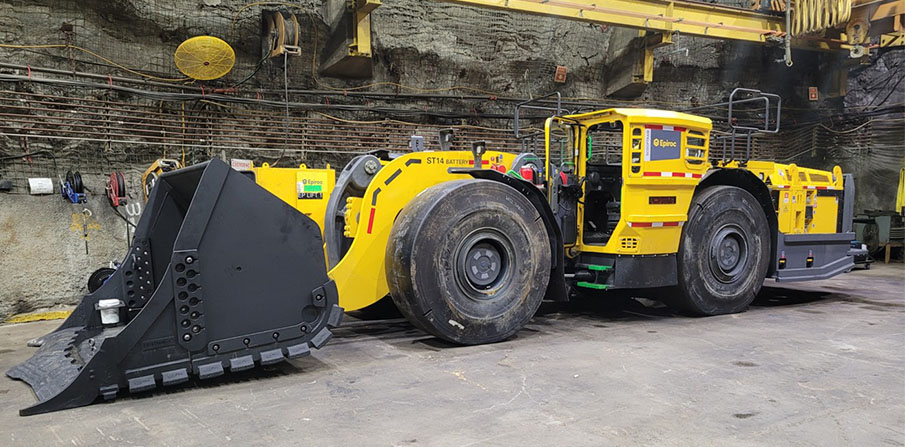
Above: Autonomous load-haul-dump vehicles are part of Glencore’s automation strategy at its Craig Mine in Ontario.
Industry Partner Spotlight
This story was provided by Glencore, a CIM Industry Partner, and appears in the June-July 2026 issue of CIM Magazine (view it in flip format here).
Advancing mining through innovation
Glencore Canada is moving the needle on autonomous, digital and electric technologies

Glencore’s Canadian operations are reshaping the mining landscape by deploying technologies that enhance safety, efficiency and sustainability across some of the country’s most challenging environments. From autonomous haulage in Nunavik, Quebec, to drone-based inspection systems in Timmins, Ontario, to the development of one of the world’s first all-electric deep mines in Sudbury, Ontario, Glencore is demonstrating how technological excellence can drive the future of responsible resource development in Canada.
Autonomous haulage in the sub-Arctic
In northern Quebec’s Nunavik region, Raglan Mine achieved a major milestone this year when its newly inaugurated Anuri Mine successfully operated its first autonomous haul truck, which completed an autonomous ramp climb and discharged ore at the surface. This achievement represents one of the most advanced applications of underground autonomous haulage in the sub-Arctic.
The mine’s automation strategy relies on Sandvik’s AutoMine platform, which Raglan Mine has been progressively integrating across its fleet. Today, the site operates multiple autonomous and semi-autonomous machines, including LH517i load-haul-dump vehicles, Toro TH663i haul trucks and intelligent drilling rigs. This gradual approach has allowed the mine to build internal expertise and to adapt processes while reducing risk.
Operating in Nunavik poses extreme logistical and environmental challenges, but the autonomous milestone proved that automation can succeed even in remote, cold-climate underground environments. Industry observers have heralded this accomplishment as a benchmark in deep-mine efficiency, signalling the future direction of mining automation as companies confront deeper ore bodies and tighter margins.
Drone-based inspections safeguard deep mining
At Kidd Operations in Timmins, Ontario, the world’s deepest base metal mine below sea level, Glencore is improving underground safety and efficiency through drone-based inspection and light detection and ranging (LiDAR) mapping technologies. More specifically, engineers deploy the Flyability Elios 3 drone to inspect vertical ore passes, narrow drifts and hazardous spaces that would be risky or time-consuming for employees to enter.
The Elios 3 drone has three core advantages:
First, it navigates areas that pose structural or environmental risks, allowing operators to capture data from a safe distance, and is used daily to reduce worker exposure to hazardous underground conditions.
Second, traditional inspections often require removing expensive loaders from operation and outfitting them with scanning equipment. With drones, comparable data can be collected within minutes, dramatically reducing operational disruptions—for example, inspections that once required major equipment reallocation now take as little as 15 minutes using the Elios 3.
And third, drone-based LiDAR scans produce detailed 3D models that support better decision-making, from identifying ore pass hang-ups to assessing stope stability and evaluating blast performance. These insights help keep operations safe, productive and aligned with long-term mine planning.
Glencore’s drone systems are more than inspection tools—they are essential components of a digitally integrated mine that prioritizes worker safety and operational excellence.
A fully electric, next-generation mine
The Onaping Depth Project at Craig Mine, part of Glencore’s Sudbury Integrated Nickel Operations, is set to become one of the world’s first deep mines designed around a 100 per cent battery-electric fleet. The project, which is expected to begin operations later this year, represents a blueprint for the future of Canadian deep mining.
The first components of a unique all battery-electric fleet of vehicles were delivered to the Onaping Depth Project in 2019 during the early stages of development. It is expected that Craig Mine will have a fleet of 66 battery-electric vehicles (BEVs) ranging from the underground mining fleet that will drill and prepare the mining face and extract ore, to service and support vehicles that move people, supplies and equipment.
Electrification is essential at Craig Mine, where the Onaping Depth Project ore body sits roughly 2,600 metres below surface. At this depth, diesel-powered fleets would require significant ventilation and cooling—one of the largest operating costs in deep mining. Designing the mine around BEVs is expected to reduce ventilation energy needs by 44 per cent and cooling demands by 30 per cent, while eliminating diesel particulate emissions underground.
In addition to electrification, Craig Mine will integrate mine-wide Wi-Fi, real-time monitoring, remote operations from surface and autonomous equipment—creating a highly digitalized, low-carbon mining ecosystem.