- dev.png)

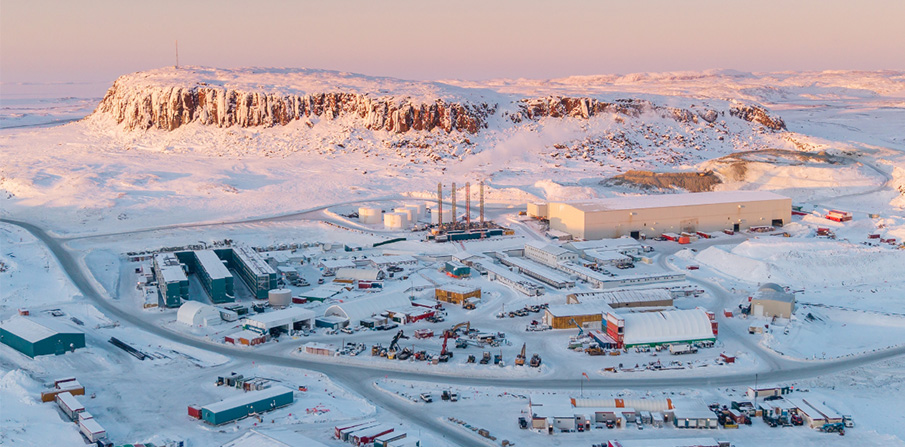
Above: An aerial view of Agnico Eagle’s Hope Bay project, March 2026.
Industry Partner Spotlight
This story was provided by Agnico Eagle, a CIM Industry Partner, and appears in the May 2026 issue of CIM Magazine (view it in flip format here).
Responsible development in the North
For Agnico Eagle, the long-term success of mining in the North depends on more than physical infrastructure

Agnico Eagle, Canada’s largest gold mining company and the world’s second-largest gold producer, is drafting a new chapter in Nunavut. Sometime before the end of May 2026, the company is expected to provide a study update and a potential construction decision for its advanced Hope Bay exploration project. For the Canadian company, which was founded in 1957, this new chapter represents far more than just a new mining project. It is also an important step in supporting Canada’s sovereignty, security and long-term economic resilience.
Located in the high-grade gold district of Nunavut’s western Kitikmeot region, the 80-kilometre-long Hope Bay greenstone belt hosts three gold deposits containing 3.4 million ounces in proven and probable reserves and more than 4.4 million ounces of gold in indicated and inferred resources. The proposed Hope Bay mine is expected to have a capacity of 400,000 to 425,000 ounces of annual gold production, which would make it one of the largest mines in the Canadian Arctic. The property has more than 90 regional exploration targets identified for potential future testing.
“Based on the geological potential and our experience,” said Sean Boyd, chair of Agnico Eagle’s board, “when you find yourself on major geological belts like this, you tend to be able to build multi-decade type businesses. So, what we see in Hope Bay is the ability to get a big mine up and running and continue an aggressive drill program while running a big mine.”
Only six years ago, the state-owned Chinese firm, Shandong Gold Mining, was poised to purchase the Hope Bay project from TMAC Resources for $230 million. Citing national security concerns, Canada’s federal government blocked the deal in December 2020. Within a matter of weeks, Agnico Eagle stepped up, purchasing the project for $286.6 million and ensuring the resource would remain under the stewardship of a Canadian firm. And not just any Canadian firm; Agnico Eagle has two decades of history in the Far North.
The company first entered Nunavut in 2007, when it purchased the Meadowbank gold mine in the Kivalliq district. In 2010, Meadowbank went into production. Nine years later, Agnico opened two other mines, Amaruq—a satellite deposit of Meadowbank—and Meliadine, both located in the Kivalliq district.
“We were drawn to Nunavut’s world-class geology,” said Boyd. “But then very quickly, as we started to engage in the community, we realized that despite the challenges of operating in the Far North, it was going to be a very good place to build a bigger business over time.”
Since 2007, Agnico has invested approximately $10 billion in building its business and infrastructure in Nunavut. It is the largest road builder in the territory and its largest private-sector employer. In addition to paying significant royalties to Inuit communities, Agnico Eagle now contributes approximately one-quarter of Nunavut’s gross domestic product, largely driven by the company prioritizing local procurement.
But for Agnico Eagle, the long-term success of mining in the North depends on more than physical infrastructure. “Being a Canadian company for almost seven decades,” Boyd noted, “we understand the responsibility we have to our employees, their families and the community. It’s not just mine building; it’s community building.”
This includes investing in education, food security and housing in Nunavut, as well as providing high-quality jobs and paying royalties to Inuit associations. Agnico Eagle pays royalties and fees directly to Nunavut Tunngavik Incorporated, which manages mineral rights for Inuit-owned lands across the territory, and the Kivalliq and Kitikmeot Inuit Associations, which respectively represent the lands where the Meadowbank and Meliadine mines and the Hope Bay project are located. Since 2007, these combined payments have totalled more than $900 million.
Additionally, Agnico has spent in excess of $5.2 billion with Inuit-owned firms. It has also invested more than $16 million in social initiatives, including $2.5 million for the Breakfast Club of Canada to ensure elementary school students in the Kivalliq and Kitikmeot regions have access to a nutritious breakfast every school day.
“Given the time we’re in as a country,” said Boyd, “I think Hope Bay is an important project now in the hands of a company that has the experience and trusted relationships in Nunavut to build it. It sends a lot of good messages to Canadians that Canadian companies can do this in the Far North, and it sends a message to our allies that we’re serious about investing in the North and developing our resource base.”
From a government investment perspective, added Boyd, “I think investing in ports and roads is good, but investments in social infrastructure in the communities are critical because you’re not going to have effective sovereignty unless you have strong communities and prosperous families within those communities.”