- dev.png)

Bobbie Gaucher - 26 November 2026
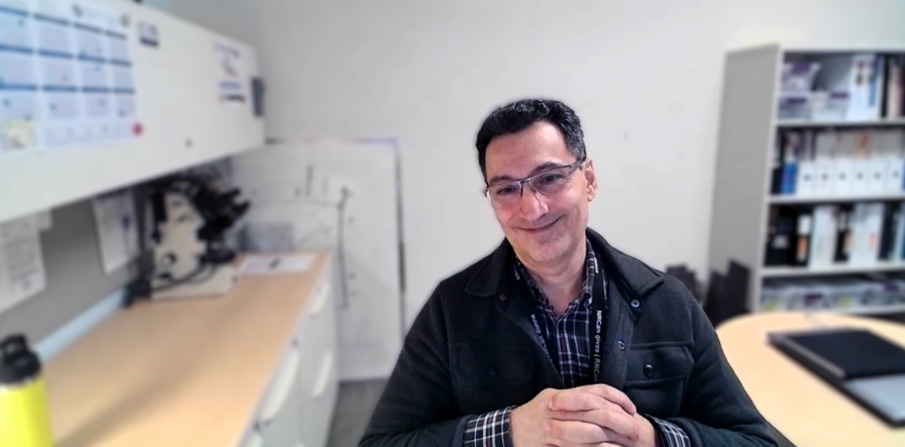
Above: Fateh Fazeli, a Research Scientist at CanmetMATERIALS, Natural Resources Canada. Courtesy of Fateh Fazeli
Uniting Canada’s steel value chain to tackle decarbonization and domestic supply-chain resilience
After approximately 10 years of inactivity, the Metallurgy and Materials Society of CIM (MetSoc) has revived its Iron and Steel Committee, establishing a forum for collaboration and technical knowledge exchange across Canada’s steel value chain.
The revival comes as Canada’s steel industry faces a period of significant transformation. Investments in decarbonization, changing infrastructure requirements and growing interest in domestic supply-chain resilience are creating new demands for steel producers, researchers and manufacturers.
For Fateh Fazeli, a Research Scientist at CanmetMATERIALS and chair of the revived committee, these developments make the timing particularly important.
Fazeli said interest in reactivating the committee had been building over the past one to two years through discussions with industry stakeholders, academic institutions and policymakers. That renewed engagement helped bring the committee back into operation in 2026.
The committee’s objective is to create a Canadian forum where professionals can exchange technical expertise, identify common challenges and collaborate on solutions that support a competitive, innovative and sustainable steel industry.
Connecting the entire steel value chain
One of the committee’s central ambitions is to broaden participation beyond traditional ironmaking and steelmaking disciplines.
Historically, much of the committee’s technical activity focused on upstream processes and the academic exchange of metallurgical research. While those areas remain important, Fazeli wants the revived committee to engage more directly with the practical challenges experienced throughout the industry.
That includes steel producers, equipment manufacturers, fabricators, researchers and end users.
“We would like to hear about some of the concerns, some of the challenges the downstream players and clients have in this entire value chain,” Fazeli explained.
He pointed to welding, heat treatment and forming operations as examples of disciplines that should be represented in the committee’s discussions.
These activities play an important role in determining how steel performs in its final applications. Bringing those perspectives into the conversation can help connect metallurgical research and production decisions with the requirements of manufacturers and infrastructure developers. The committee also intends to strengthen connections between industry, universities, research organizations and government.
Fazeli’s own career reflects that intersection. After completing his PhD in 2004, he worked across academia and industry, including applications in transportation and energy, before joining the federal government as a scientist. His experience has reinforced the value of connecting technical expertise with industry needs and national priorities.
For the revived committee, that means creating opportunities for professionals across the supply chain to learn from one another and identify areas where collaboration can advance Canadian steel capabilities.
Responding to a changing industry
The committee’s technical priorities reflect some of the most significant challenges facing the Canadian steel sector, such as decarbonization.
Steel producers are exploring alternative approaches to ironmaking and steelmaking that can reduce emissions while maintaining the quality, performance and cost competitiveness required by industrial customers.
The committee plans to examine developments involving hydrogen and biocarbon as alternative reductants, increased use of recycled feedstocks, carbon capture technologies and electric arc furnace/direct reduced iron (EAF/DRI) production routes. Canada has several advantages that could support this transition.
Fazeli highlighted access to renewable electricity, particularly hydroelectricity, and high-purity iron ore deposits in Quebec and Labrador as important foundations for producing lower-emission iron and steel. Together, these resources could help position Canada as a competitive supplier of lower-carbon steel products.
However, realizing that potential will require coordination across the supply chain, from resource extraction and energy infrastructure to steel production and downstream manufacturing.
Some Canadian mineral deposits are located in northern regions where additional infrastructure would be required to support development. Fazeli emphasized that collaboration between government and the private sector, supported by appropriate long-term strategies, will be essential to overcoming those challenges.
Beyond decarbonization, the committee will examine how evolving industrial applications are changing the technical requirements placed on steel. These include materials for pipelines and infrastructure transporting hydrogen, carbon dioxide and alternative fuels, as well as high-performance steels for defence and marine applications.
Each application introduces distinct challenges related to material properties, manufacturing processes, performance and qualification. By connecting producers with researchers and end users, the committee hopes to support technical discussions that address these requirements throughout the steel value chain.
Building domestic capabilities
For Fazeli, the committee’s revival is also closely connected to questions of Canadian industrial competitiveness and supply-chain resilience. Major investments in energy, transportation, defence and other strategic infrastructure are expected to create opportunities for domestic steel producers.
Fazeli sees particular potential in developing specialized, value-added products rather than focusing exclusively on commodity steel. He pointed to high-performance steels, advanced manufacturing technologies and high-quality Canadian feedstocks as areas where domestic expertise could provide a competitive advantage.
Canada has many of the resources required to support an integrated steel supply chain, including iron ore, alloying materials and renewable energy. The challenge is connecting those advantages with the infrastructure, technologies and industrial capacity needed to produce steel products for demanding applications.
Fazeli believes the committee can contribute by bringing together organizations that might otherwise approach these challenges separately. Through technical exchange and collaboration, the committee aims to help identify opportunities where Canadian research, manufacturing expertise and industrial investment can reinforce one another.
Turning collaboration into technical programming
The committee intends to translate these priorities into regular opportunities for knowledge exchange and professional development. A central part of its approach will be industry-driven programming that brings practical experience into technical discussions.
While academic publications and conferences remain valuable, Fazeli emphasized the importance of hearing directly from professionals working with steel production and manufacturing challenges. The committee plans to invite industry experts to share their experiences, technical priorities and perspectives on emerging opportunities. Its activities will include webinars, workshops, publications, technical sessions, symposia and training. The committee also intends to support mentoring and professional development opportunities for students and early-career professionals.
Its longer-term programming includes a dedicated Iron and Steel session at the Conference of Metallurgy and Materials (COM) 2027, bringing together expertise from industry, academia, government laboratories and international organizations. Additional plans include targeted workshops, followed by a focused symposium and short courses at COM 2028.
The committee is chaired by Fateh Fazeli, with Joydeep Sengupta of ArcelorMittal serving as vice-chair. As the committee expands its activities, MetSoc is encouraging professionals from across the steel value chain to participate, contribute technical knowledge and help shape future programming.
Upcoming webinar: Before Energy Flows — The Steel Building Canada’s Future
The committee’s first webinar will examine the essential role of domestically produced steel in supporting Canada’s energy infrastructure.
Before Energy Flows: The Steel Building Canada’s Future will take place on Wednesday, December 2, 2026, from 1 to 2 p.m. EST. The webinar will explore how steel supports energy applications ranging from conventional oil and gas to carbon capture and hydrogen infrastructure, presented by Michael Gaudet, PhD, Manager of Metallurgy, R&D at InterPro Pipe + Steel.
Drawing on InterPro Pipe + Steel’s experience as a vertically integrated steel and pipe producer, Gaudet will discuss the manufacturing processes behind these applications, including scrap recycling, steelmaking, rolling, pipe forming and welding. The presentation will also examine how evolving energy infrastructure requirements are driving advances in steel metallurgy and manufacturing.
The webinar reflects the revived committee’s commitment to connecting technical expertise with real-world industrial challenges and creating opportunities for collaboration across Canada’s steel sector.
Learn more about the Iron and Steel Committee and how to get involved ➜