- dev.png)


Insights from our peer-reviewed journal | Compiled by Megan Skrip - 10 April 2026
New research highlights the essential role of footprint optimization in Canada’s journey toward net-zero mining
To balance increasing demand for critical minerals with a commitment to achieve net-zero greenhouse gas emissions by 2050, a recent analysis has found that Canadian metal mines must engage in early planning to optimize site design, waste management and land rehabilitation in order to manage the emissions-related repercussions of land-use change.
“As regulators tighten climate expectations, mining companies may need to account for the carbon emissions from cleared or disturbed land at their sites, not just the emissions from fuel consumption,” said Connie Smith, lead author of the study and a mining engineer with the climate change mitigation team at Natural Resources Canada’s CanmetMINING.
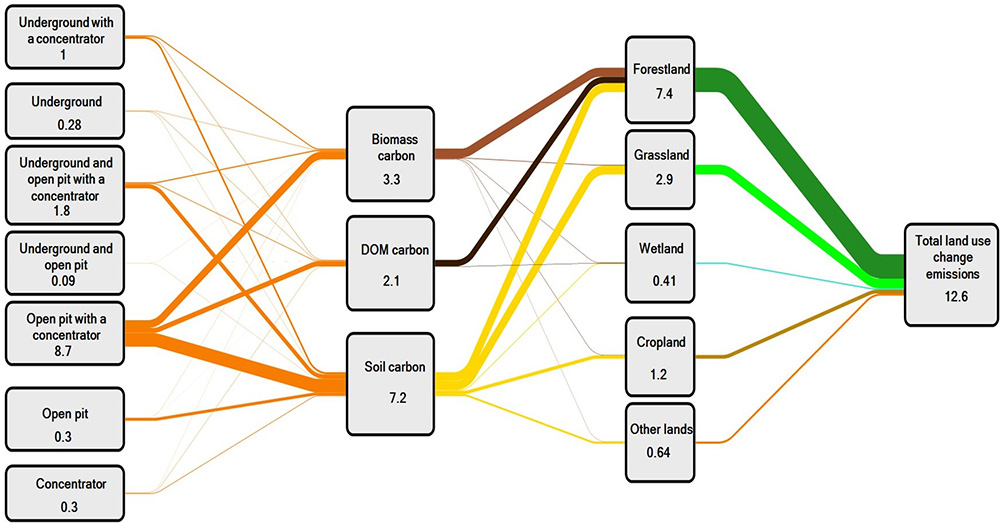
Above: This Sankey diagram shows the estimated greenhouse gas emissions (Mt CO2e) from land use change at active mine sites in Canada between 2001 ± 1 and 2019 ± 1. (CIM Journal, Vol. 16, No. 4.)
By using satellite imagery to measure changes in the infrastructure footprints of 85 active metal mine sites in Canada between approximately 2001 and 2019, Smith and her co-authors found that land conversion released a total equivalent of 12.6 million tonnes of carbon dioxide, and that emissions varied by mine type and original land use.
Open-pit mines with concentrators had the largest infrastructure footprints and therefore the highest associated emissions, with waste piles and tailings storage facilities at one site accounting for 76 per cent of its total footprint. Mines located in forestlands had higher carbon emissions than those in grassland, wetland, cropland or other land-use categories. The researchers highlighted the need for a “like for like” approach to rehabilitation plans, given that, for example, remediating a once-forested site to grassland will not offset carbon losses.
“The emissions from forests, grasslands and wetlands being converted to mine infrastructure are significant,” said Smith, “and careful planning and rehabilitation will be essential to reducing impacts.”

Study co-authors left to right: Osama Asa’d, Michelle Levesque, Connie Smith, (Daniel Jewell not pictured)
The CIM Journal is a quarterly digital publication for peer-reviewed technical papers available to all CIM National Members as a membership benefit and to non-members for a fee. Papers cover all facets of the mining and minerals industry, including geology, mining, processing, metallurgy, materials, maintenance, environmental protection and reclamation, mineral economics, project management, health and safety, risk management, research and development, operations, and regulatory practices and issues.
Since 2020, the CIM Journal has been published by Taylor & Francis. The editorial process remains the same and CIM National Members continue to have free access to the journal. New papers, in addition to the archives, are now hosted on the CIM Journal site at Taylor & Francis. Papers published prior to 2020 can be found on the CIM Technical Paper Library or on OneMine.
To ensure you can access this CIM Member benefit, please ensure you are logged in to your CIM account.