- dev.png)

Bobbie Gaucher - 27 November 2026
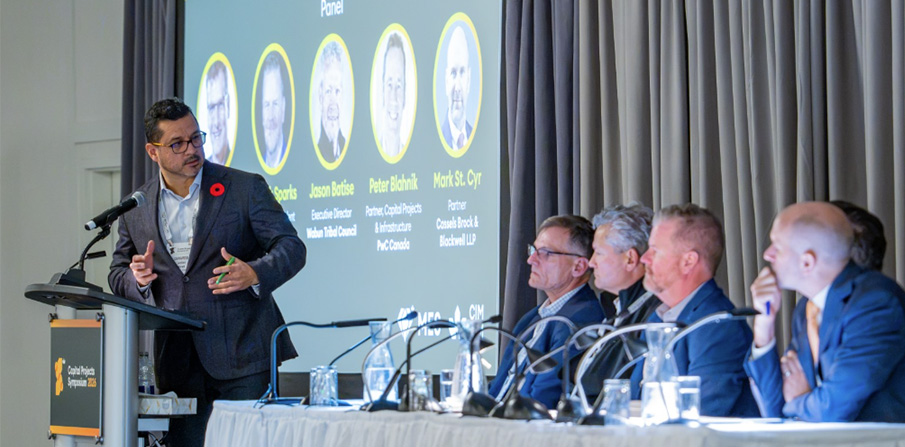
Above: Panel - Cross Sector Learning: Mining, Transit, Energy, and Infrastructure Converge featuring Glen Kuntz, Senior Vice-President, Mine Development, Ivanhoe Electric Inc.; Patrick Sparks, Senior Vice President, Kiewit; Jason Batise, Executive Director, Wabun Tribal Council; Peter Blahnik, Partner, Capital Projects & Infrastructure, PwC Canada; and Mark St Cyr, Partner, Cassels
At CIM's Capital Projects Symposium (CPS), organized by the Management and Economics Society of CIM (MES), industry leaders explored the capabilities Canada needs to turn mineral wealth into investable projects, successful operations and lasting economic value. Canada has the resources the world needs. The greater challenge is delivering the projects that will bring them into production.
That distinction defined CPS, which brought together a record 294 attendees to examine what stands between resource potential and successful project delivery.
Across keynotes, technical presentations and panel discussions, the central message was that rising demand and strong mineral endowments are not enough. Projects must be financeable, supported by meaningful partnerships, designed for operational success and capable of creating long-term value.
In the conference’s opening keynote, Théophile Yameogo, America's Metals & Mining Leader at EY, identified four capabilities that will distinguish industry leaders: certainty, trust, partnerships and execution excellence.
“The next cycle will reward the organizations that create certainty, earn trust, mobilize partnerships and execute with discipline.” Those capabilities provided a common thread for the conversations that followed.
Certainty starts long before financing
Strong demand creates opportunity. It does not, on its own, make a project investable. Ammar Al-Joundi, President and CEO of Agnico Eagle Mines Limited, put trust at the centre of the investment equation. “For capital, nothing happens without trust,” he said, urging developers to “build trust by overpreparing for risk.” That means approaching financing as an integral part of project development rather than a final hurdle.
Olga Kovalik, Chief Operating Officer of Torngat Metals, described investability as a web of interdependencies crossing markets, permitting, infrastructure, community acceptance and execution readiness. A project is only as strong as its weakest link, and that link can change over the course of a project.
For Randy Smallwood, Chair of the Board and Director of Wheaton Precious Metals and incoming CIM President, disciplined technical due diligence is essential to understanding those risks. Geological confidence, metallurgy, permitting, operating assumptions and capital requirements all influence whether a project can secure investment. Project certainty is built by addressing risks together, not by advancing individual workstreams in isolation.
Indigenous ownership changes the project equation
Indigenous partnerships were another defining theme, with speakers challenging the industry to move beyond consultation toward shared ownership, decision-making and long-term economic participation.
Reagan Harding, Director of Economic Development and Major Projects at Métis Nation–Saskatchewan, highlighted how Indigenous equity participation can strengthen project financing and create lasting community wealth. But he also identified barriers that receive less attention such as legal fees, upfront financing costs and lengthy negotiations that communities must navigate before projects generate revenue.
His message challenged lenders and governments to make participation more accessible and to recognize that a mine's value extends beyond the orebody itself.
Jason Batise, Executive Director of Wabun Tribal Council, reinforced that meaningful engagement cannot begin after major decisions have already been made. His presentation, Partnership, Not Permission, called for Indigenous communities to help shape projects from the outset.
A practical example came from Mark St Cyr, Partner at Cassels, who discussed the First Nation-led Webequie Supply Road. Its partnership model incorporates community governance, joint ventures and opportunities to build local capacity.
Together, these perspectives reframed Indigenous participation as central to project certainty and durability, not simply a requirement on the path to approval.
Execution excellence means delivering an operation that works
A project can be completed as designed and still fall short of what operations need. That distinction drove the panel Execution Excellence – Ensuring the Project Delivered Meets the Needs of the Operation, moderated by Tyler Buckingham of DRA Americas Inc.
Graeme Goodall, Vice President of Engineering and Operations at Frontier Lithium, argued that operational managers should be involved before design reaches 60 per cent completion. John Davidson, VP, Head of Capital Sales North America at FLS, emphasized the value of early supplier engagement in identifying problems before they become costly.
For James Connolly, Executive Vice President at Tiernan Gold Corp, managing complexity is equally important.
“Keep it simple, or keep it small.”
The discussion reinforced the principle heard throughout CPS, commissioning, ramp-up and long-term performance must shape decisions from the earliest stages of development.
Shaun Usmar, CEO of Vale Base Metals, brought that principle into focus through the company's operational transformation. He described how stronger planning, greater accountability and empowered operators helped improve performance and position the business for growth. “The choice shouldn't be between doing it quickly and doing it right,” he said. “We should do it right quickly.”
Execution excellence, speakers argued, is not simply about meeting construction schedules. It is about delivering an asset capable of performing reliably from the start.
Keeping more value in Canada
The conversation was not limited to individual projects but a national question: How can Canada turn its mineral resources into lasting economic advantage?
In a ministerial address delivered on behalf of Ontario's Minister of Energy and Mines, Rudy Cuzzetto, MPP for Mississauga–Lakeshore, highlighted efforts to accelerate project approvals while expanding domestic processing capacity. “Keep the value here, at home,” he urged. The message resonated across discussions about critical minerals, supply chain security and infrastructure.
Nicole Uher of Natural Resources Canada's Critical Minerals Centre of Excellence outlined federal efforts to coordinate funding, address infrastructure gaps and strengthen critical mineral supply chains as priorities evolve to include defence and national security.
Speakers repeatedly emphasized that roads, power, communications and community infrastructure are not secondary considerations. They can determine whether projects advance at all.
Workforce readiness was equally important. While artificial intelligence is helping drive demand for metals such as copper, Usmar reminded delegates that physical development still depends on people.
“Mines, smelters and refineries are not built by AI, they are built by people.”
The opportunity for Canada, then, is not only to increase mineral production. It is to strengthen the industrial capacity, expertise and partnerships needed to capture more value across the supply chain.
The next measure of success
CPS 2026 made clear that the industry's biggest challenges are interconnected.
Capital follows credible plans. Credible plans depend on technical discipline, infrastructure and operational readiness. Meaningful Indigenous partnerships strengthen project development and create opportunities for shared prosperity. And Canada's competitiveness depends on its ability to turn resources into productive assets and domestic economic value.
Certainty, trust, partnerships and execution excellence are therefore more than leadership principles. They are the capabilities that connect resource potential to project delivery.
As the industry looks toward its next generation of investments, success will be measured not only by the projects announced or approved, but by the operations brought into production, the partnerships sustained and the value created.
CIM's Capital Projects Symposium returns November 7–9, 2027, in Vancouver, continuing the conversation about what it takes to move from ambition to execution.
Learn more about the Management and Economics Society of CIM ➜