- dev.png)

Bobbie Gaucher - 06 July 2026
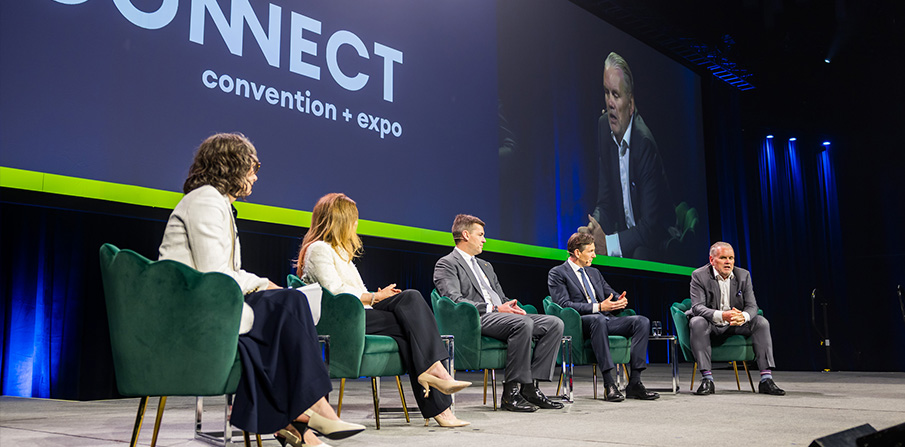
Above: The conference opened with a high-impact plenary moderated by Lucy Potter and featuring Jonathan Price, Randy Smallwood, Catherine McLeod-Seltzer and Adam Lundin.
Mining confronts its defining moment
CIM CONNECT 2026 arrived in Vancouver at a time when the mining industry is facing both pressure and opportunity. Over the first week of May, one message surfaced repeatedly across plenaries, technical sessions, special forums and hallway conversations: mining is no longer preparing for the future. It is being asked to deliver it now.
Built around the theme Our Mining Moment: Strategic Growth and Sustainable Operations, this year’s conference moved beyond broad optimism and focused instead on execution. Speakers challenged the industry to think harder about how projects are delivered, how partnerships are built, how technology is implemented and how sustainability is operationalized in real time.
“This year’s theme captures both the opportunity and responsibility in front of us,” said Rudy Zdravlje, technical director, strategic planning at Teck Resources Limited, during opening remarks. “Ask questions, share what is working, visit the Expo, reconnect with colleagues and make time to meet someone new.”
From “just in time” to “just in case”
The conference opened with a high-impact plenary featuring Jonathan Price, president and CEO of Teck Resources Limited; Randy Smallwood, non-executive chair of Wheaton Precious Metals; Catherine McLeod-Seltzer, director at Teck Resources Limited and 2026 Canadian Mining Hall of Fame inductee; and Adam Lundin, chair of Lundin Mining Corporation. Moderated by Lucy Potter, general manager of Rio Tinto’s Commercial Group, the panel asked a central question: what makes this mining cycle different?
The answer, according to the panelists, is urgency.
“We are in an effervescent moment,” said Potter. “What is different now?”
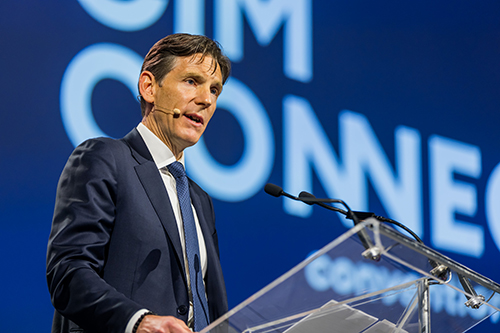 Jonathan Price, president and CEO of Teck Resources Limited
Price pointed directly to electrification, AI infrastructure and supply chain pressure. “Just in time is becoming just in case,” he said during his keynote address. The world’s demand for copper, aluminum and critical minerals is accelerating faster than mining’s ability to responsibly supply them. While the industry has long understood the coming demand wave, Price argued that governments and society are only now fully recognizing mining’s strategic importance.
“The world needs more Canada,” he said, referring to the country’s collaborative approach, stable governance and reputation for responsible resource development.
Yet several speakers warned that Canada cannot rely on reputation alone. McLeod-Seltzer emphasized that stakeholder expectations have risen alongside industry performance. Collaboration between governments, communities and industry is no longer optional but foundational.
Lundin argued that mining has a narrow but important window to explain its value to communities through long-term infrastructure investment and meaningful partnerships. “The swing to focus on sustainability and going beyond closure to building local infrastructure that will last for decades” represents a fundamental shift in how projects are viewed, he said.
Smallwood captured the pressure facing the sector succinctly: “It is up to us to deliver it to society in a responsible manner.”
Strategic growth now depends on trust
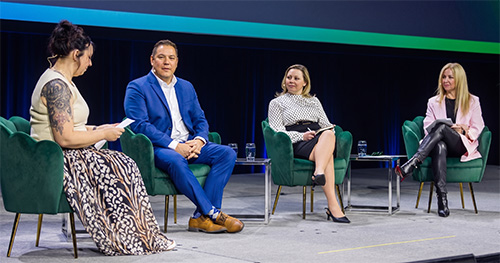
The week’s Strategic Growth panel pushed this conversation further by examining the growing intersection between economic development, Indigenous partnership and project certainty.
Moderated by Julie Ann Wriston, director of Indigenous relations at Nutrien, the panel featured Ron Hyggen, CEO of Kitsaki Management Limited Partnership; Heather Exner-Pirot, director of energy, natural resources and environment at the Macdonald-Laurier Institute; and Karla Mills, executive vice president and chief project development officer at Teck Resources Limited.
Hyggen emphasized that Indigenous communities increasingly expect to be treated as true partners rather than stakeholders consulted late in the process.
“We want to find that path together,” he said.
For Hyggen, sustainability planning must extend beyond current leadership cycles and be grounded in long-term thinking. He noted that Indigenous nations are increasingly collaborating among themselves to share lessons on agreements, project structures and community benefits.
Exner-Pirot argued that Canada’s current opportunity in critical minerals requires ambition, not hesitation. “It’s not enough for Canada to be neutral,” she said. “We need to be growing the global market share.”
Meanwhile, Mills focused on operational realities. “We embed risk into the baseline,” she explained, stressing that delaying difficult conversations around risk, timelines or partnership sensitivities only creates larger problems later in development.
Together, the panel reinforced that growth in mining today is no longer measured solely by production or investment. It is increasingly measured by trust, transparency and the ability to maintain alignment between industry, governments and communities.
Sustainability moves from ambition to operations
By the final day of the conference, discussions around sustainability had shifted away from aspirational language toward operational realities.
“We need to ground our optimism in reality,” Warren said. “We need to get it right by getting operations sustainable on the ground.”
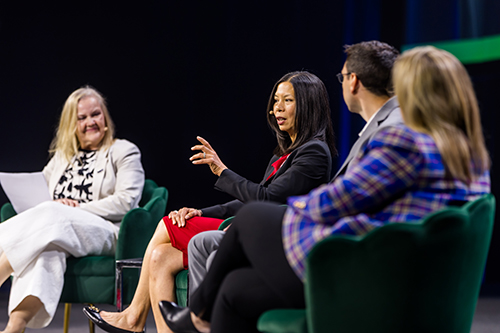 Wednesday panellists Sylvie Tran, Phil Wallace and Daley McIntyre with moderator Lesley Warren
Sylvie Tran, vice-president of OEMS and environment, health and safety at Suncor, described the growing complexity surrounding water management and regulatory uncertainty. Water, she noted, is now central to discussions involving communities, operations and governments simultaneously.
Phil Wallace, general manager of Highland Valley Copper at Teck Resources Limited, emphasized that sustainability challenges are often symptoms of earlier decisions. “You cannot flowsheet your way out of this,” he said, arguing that investments in people, communities and workforce diversity must happen early to avoid future constraints.
Daley McIntyre, general manager of Cameco’s Key Lake operation, brought a community-centered perspective rooted in northern Saskatchewan. “I don’t use the word sustainability,” she said, “but everything I do embodies the values of sustainability.”
For McIntyre, strong community relationships are not external to operations—they are operational strategy itself.
Technology only works if operations are ready
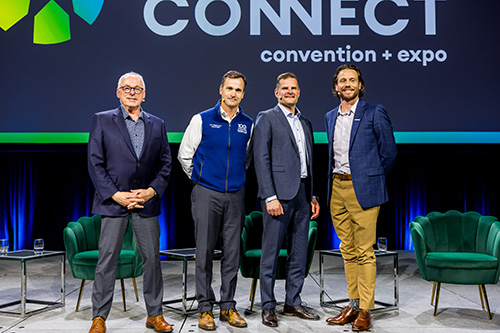 CIM President John Rhind with Corey Wurtzbacher, Riku Pulli and Braden Weisheit
Rather than debating which technologies will transform mining, the discussion focused on what determines whether those technologies succeed.
Across the panel, the message was remarkably consistent: operational fundamentals still come first.
CIM President John Rhind framed the discussion simply: "It's not just about the equipment. It's about optimizing the operations."
Corey Wurtzbacher of Caterpillar explained that AI only delivers value when organizations are prepared to interpret and act on the information it generates. Sandvik's Riku Pulli emphasized that successful adoption depends more on people and processes than on the technology itself. Komatsu's Braden Weisheit summarized the challenge succinctly: "Automation is not a silver bullet — it exposes bottlenecks."
The discussion reinforced one of the conference's central themes. Mining's competitive advantage will not come from adopting technology the fastest, but from building operations capable of making the most of it.
Mining's future depends on integrated thinking
Several forums throughout the week broadened the conversation beyond mine sites and technical systems, illustrating that operational excellence increasingly depends on how the industry approaches water stewardship, workforce development and leadership.
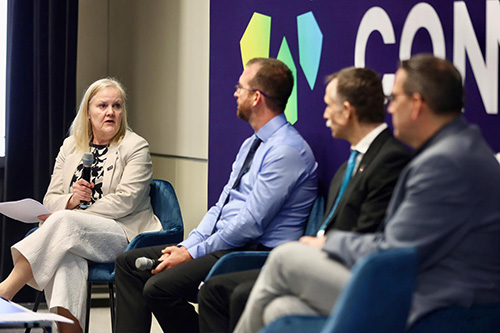 Mine Water Strategy Forum speakers with moderator Lesley Warren
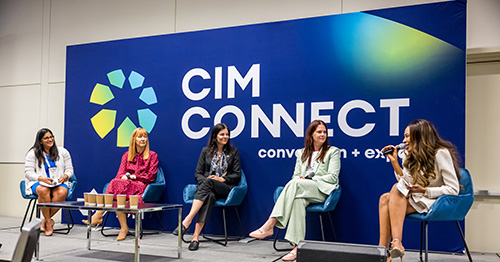 Mining for Inclusivity panellists with moderator Angelina Mehta
 Tina Gauthier of Vale Base Metals challenged organizations to rethink how they identify and develop talent. "We need to stop limiting ourselves to the people who are traditionally qualified," she said. Her call to actively sponsor emerging leaders echoed a broader message heard throughout the conference: the industry's future will be shaped by its ability to bring different perspectives into the rooms where decisions are made.
The future of mining was already in the room
That future was perhaps most visible in the student programming throughout the week. More than 100 students participated in the Speed Student Mentorship event, connecting directly with over 25 industry mentors. The student ePoster competition showcased exceptionally high-quality technical work, reinforcing the conference's emphasis on practical learning and knowledge sharing across generations.
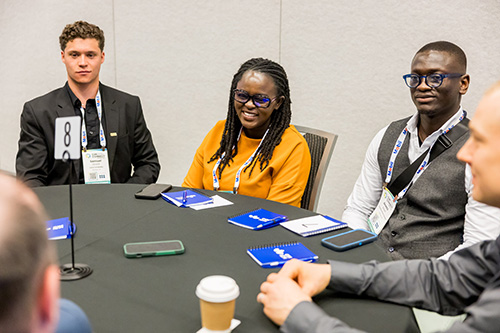 Speed mentoring
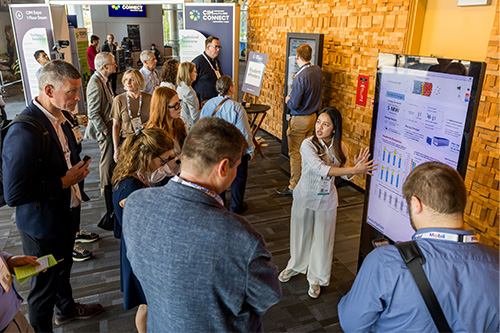 Student posters
Throughout the week, CIM Past President Candace MacGibbon returned to a common idea: mining advances when experience is shared. Whether discussing mentorship, Indigenous partnerships, diversity or technical excellence, she repeatedly emphasized that collaboration, not individual achievement, will determine the industry's success.
During the student awards presentation, she reminded attendees that "a lot of what we learn in the industry doesn't come from the classroom." It was a fitting reflection of CIM CONNECT itself, where technical expertise, operational experience and professional relationships came together to prepare the next generation of industry leaders.
Final takeaways from CIM CONNECT 2026
By the time conference attendees left Vancouver, one conclusion had emerged across every stage, technical session and hallway conversation: mining's defining challenge is no longer identifying what needs to change—it is delivering that change at the speed the world now requires.
Whether the conversation centred on critical minerals, Indigenous partnerships, AI, water stewardship, workforce development or capital allocation, speakers consistently returned to the same principle: progress depends on integration. Technology must support operations. Sustainability must be embedded in decision-making. Partnerships must begin long before projects do. And leadership must extend beyond organizations to the broader mining ecosystem.
The theme, Our Mining Moment, ultimately proved to be less of a slogan than a call to action. CIM CONNECT 2026 demonstrated that the industry already possesses many of the ideas, technologies and expertise needed to meet the moment. The challenge now is bringing them together responsibly, collaboratively and with the confidence to act.
Explore CIM CONNECT themes on CIM Academy
Want to stay in the loop of upcoming events?