- dev.png)

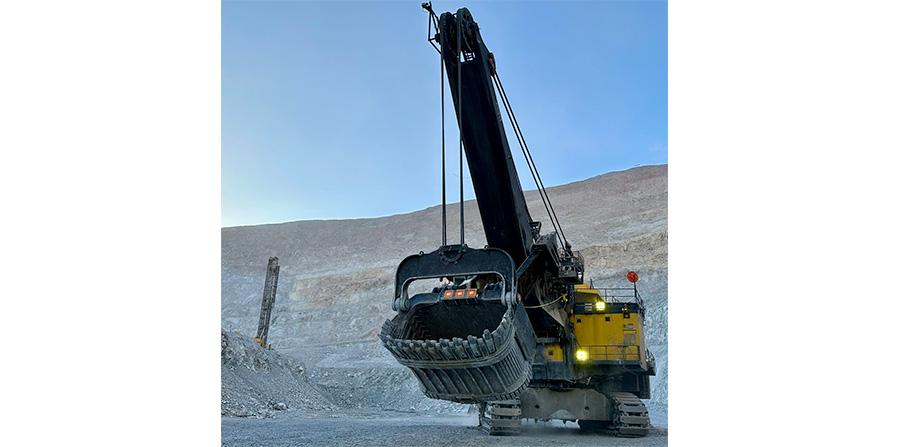
Above: With ShovelSense installed directly inside a shovel, every bucketful delivers specific, real-time data on its contents.
Industry Partner Spotlight
This story was provided by MineSense, a CIM Industry Partner, and appears in the June-July 2026 issue of CIM Magazine (view it in flip format here).
From uncertainty to insight at the mine face
MineSense’s technology can help rapidly increase critical minerals production

Limited visibility into ore grade at the mine face has long placed practical limits on how efficiently the world can unlock the minerals it depends on. Even with sophisticated modelling and sampling tools, uncertainties in the ore body have constrained recovery and slowed production gains at a time when global demand is rising faster than traditional methods can keep pace with. MineSense Technologies set out to change this dynamic. By delivering real-time clarity at the point of extraction, the company is helping mines capture more value from existing operations and address the growing pressures on critical minerals supply.
The scale of the challenge is significant. In spring 2025, for example, the International Energy Agency warned that, unless something changes within the next decade, the world could fall 30 per cent short of projected demand for critical minerals like copper. That shortage could begin to be felt within just five years. “Dozens of new copper mines would need to be online by 2030 to meet projected demand,” said John Slaven, MineSense’s CEO. “Yet a single mine can take over 15 years to reach production. We are facing an imminent shortfall, and we need practical solutions that can be deployed immediately.”
Intelligent game changer
From MineSense’s perspective, a solution already exists in its innovative digital mining technologies. The company’s flagship product, ShovelSense, is a rugged X-ray fluorescence-based system that delivers real-time ore characterization directly at the mine face. The system connects directly with a mine’s fleet management system, enabling real-time routing decisions at the point of extraction. In 2019, the company also introduced BeltSense, which, when used sequentially with ShovelSense, adds further precise ore measurements on downstream conveyors.
ShovelSense is built on the premise that the most important step in revolutionizing the mining process is the first one—the moment a shovel digs into blasted rock. Practically every investment a mining operation makes in recovery optimization and downstream processes is ultimately determined by what is loaded into the bucket. Conventional modelling and blasthole data provide only general information and assumptions. But with ShovelSense installed directly inside the shovel, every bucketful delivers specific, real-time data on its contents.
“This allows for immediate decisions as to whether the material should go to processing or to waste,” said Anne Bulik, MineSense’s president and chief operating officer. “The mining industry invests heavily in plant upgrades trying to get as much output as possible, but all of that is done after the material has been extracted. That is inherently inefficient. Whether the material should be processed or go to waste should be decided at the point of extraction.”
The benefits of this are multifold, but the most transformative one is that it sorts out waste before it reaches the mills and, at the same time, helps prevent valuable bucketfuls of ore being blindly discarded.
“We found that across our current portfolio, MineSense assessments result in about a 10 per cent redirection of trucks, which has enabled over 24,000 tonnes of incremental copper production,” said Bulik. In a published case study from Newmont regarding the Red Chris mine, the company was able to recover 1.6 million tonnes of ore from material previously classified as waste over a 12-month period. Results such as these illustrate how MineSense solutions can help rapidly increase critical minerals production by maximizing recovery in existing operations without the need to wait for the construction of new mines.
Taking it to the next level
MineSense has been growing rapidly globally. The company has added a regional office in Chile and has installations across North and South America as well as in Australia. In October 2025, the company was recognized by Deloitte’s 2025 Technology Fast 50 awards program for its rapid growth, entrepreneurial spirit and bold innovation. But in many ways, the company is just getting started. Currently, its research and development is focused on leveraging the rich data its system collects, along with artificial intelligence, to help clients take precision sorting and operational optimization to the next level.
“We’re focused on capturing data that our clients can put to work immediately,” said Bulik. “This allows them to quickly adapt to changing material conditions and continuously improve performance and efficiency in ways that haven’t traditionally been possible in the industry.”