- dev.png)

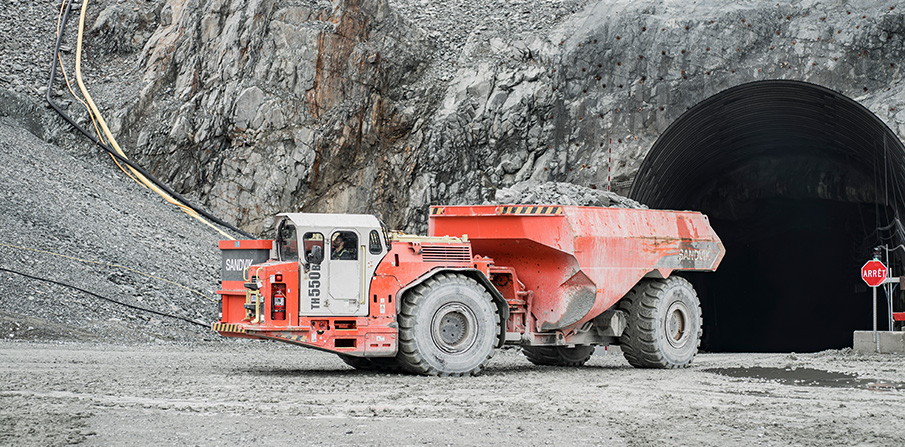
Above: A battery-electric haul truck at the Lamaque Complex, where Eldorado Gold’s early experience with BEVs is helping shape the future of underground mine electrification.
Industry Partner Spotlight
This story was provided by Eldorado Gold, a CIM Industry Partner, and appears in the November 2026 issue of CIM Magazine (view it in flip format here).

Powered by experience
From battery-electric vehicles to fleet standardization, Eldorado Gold is leveraging lessons learned across its operations to build a practical approach to underground mine electrification
As mining companies look to reduce emissions while improving productivity, electrification is becoming an increasingly important part of underground mine design. For Eldorado Gold, the journey has been shaped by both operational experience and long-term planning, with lessons learned at one operation helping to inform the next.
At the Lamaque Complex in Quebec, Eldorado was an early adopter of battery-electric vehicles (BEVs), testing the technology in a working underground mine and developing the expertise needed to support it. Today, those learnings are helping to shape the McIlvenna Bay mine in Saskatchewan, where electrification was incorporated into the mine design from the outset.
“Our electrification journey at Lamaque has been challenging but rewarding,” said Martin Pichette, senior director, mining operations and technology. “We had the courage to be an early adopter and test BEVs in a real operating environment. The preparation, infrastructure and workforce readiness required upfront have paid off.”
Introducing battery-electric equipment required far more than replacing diesel-powered machines. The Lamaque team invested in infrastructure, workforce training and maintenance capabilities while working closely with equipment manufacturers to understand the technology’s operating requirements underground.
Over time, the operation developed the expertise needed to integrate BEVs into the mining cycle and realize its benefits.
Battery-electric haul trucks have demonstrated approximately 35 per cent higher productivity than comparable diesel units while reducing fuel consumption, ventilation requirements and maintenance costs. Electrification has also contributed to an improved underground working environment through lower noise levels, reduced heat and the elimination of diesel emissions.
“I strongly believe that battery-electric technology is here to stay,” said Pichette. “The benefits are clear across the board, from reducing emissions and improving ESG performance to increasing operational efficiency and enhancing underground safety.”
While Lamaque provided valuable operational experience, McIlvenna Bay presented an opportunity to build on those lessons from the beginning.
Electrification was incorporated into the mine design during the planning stage, allowing the project team to consider battery-electric equipment alongside charging infrastructure, maintenance facilities and workforce development requirements. The objective was not simply to introduce BEVs, but to create a modern underground mining system capable of delivering both operational and environmental benefits.
“Electrification was an important consideration during the design phase,” said Sam Renelli, vice-president, underground mining. “The objective was not simply to adopt electric equipment, but to select technology that could deliver the required operational and economic performance.”
The project is expected to benefit from reduced diesel consumption, reduced greenhouse gas emissions and decreased ventilation requirements compared to a project using conventional mining equipment while supporting a productive underground operation.
A key advantage for Eldorado is the ability to transfer knowledge between operations. Teams from Lamaque and McIlvenna Bay have shared lessons learned on equipment commissioning, charging infrastructure, maintenance practices and operational integration. By applying experience gained at Lamaque, the company has been able to shorten learning curves and reduce implementation risk at McIlvenna Bay.
This approach is also supported by efforts to standardize mobile equipment where it makes sense across the business. Common equipment platforms can simplify training, reduce spare parts requirements and make it easier to transfer technical expertise between operations while creating opportunities to apply lessons learned more consistently across sites.
“Standardizing our fleet has allowed us to move beyond traditional supplier relationships and establish strategic partnerships with our OEMs,” said Fernando Carrascal, senior director, global supply chain and procurement. “Those partnerships provide access to leading technologies and specialized expertise while helping us improve equipment performance, share knowledge across operations and create efficiencies throughout the business.”
For Eldorado, electrification is not a standalone initiative. It is part of a broader effort to build safer, more productive and lower-emission mining operations.
“The real opportunity comes from integrating the equipment with the mine plan, infrastructure, workforce capabilities and operating processes,” said Simon Hille, executive vice-president and chief operating officer.
As battery technology continues to evolve, Eldorado’s experience at Lamaque and McIlvenna Bay helps demonstrate how electrification can move beyond pilot projects and become part of a practical operating model for underground mining. By combining operational experience, knowledge sharing and long-term planning, the company is building the capabilities needed to support the next generation of underground mines.