- dev.png)

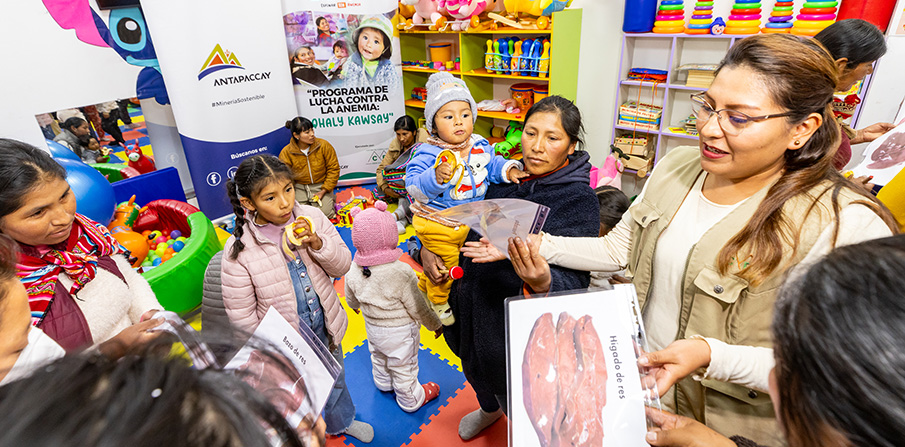
Above: Families participate in a Qhaly Kawsay early-childhood development session focused on nutrition and wellness.
Industry Partner Spotlight
This story was provided by Franco Nevada, a CIM Industry Partner, and appears in the March-April 2026 issue of CIM Magazine (view it in flip format here).

An alliance to combat childhood anemia
Franco‑Nevada is partnering with a local operator in Espinar, Peru, on an ongoing, community‑driven, long‑term social initiative
Toronto-based Franco-Nevada Corporation, a global leader in gold-focused royalties and streams, considers ethical and sustainable mining central to both its corporate strategy and its responsibility to investors and communities alike.
“We are committed to partnering with operators on community initiatives where we have royalty and streaming interests,” said Paul Brink, president and CEO of Franco-Nevada. “These partnerships help address real community needs, support operators’ social licences to operate, and reflect our belief that responsible mining investment must deliver shared, long-term value.”
The Qhaly Kawsay project in Espinar Province, in Peru’s Cusco region, exemplifies this approach. Implemented in partnership with Compañía Minera Antapaccay—a subsidiary of Glencore that operates a large copper mine in the high-Andean communities of Espinar—the multi-year initiative is designed to help reduce childhood anemia and chronic malnutrition among vulnerable populations, including pregnant women and children. By focusing on prevention, nutrition and community health outcomes, the program aims to deliver lasting benefits that extend well beyond the moment of any single intervention.
In 2024, the communities in the area faced a significant public health crisis. An estimated 16 per cent of children under the age of three were chronically malnourished, while 23 per cent were suffering from anemia. Anemia also affected nearly a quarter of pregnant women.
Franco-Nevada joined forces with Compañía Minera Antapaccay and Espinar’s Roman Catholic diocese, the Diocese of Sicuani, to develop a plan to address the crisis. That plan, the Qhaly Kawsay program, was designed to strengthen maternal and child health in the high-Andean communities of Cusco through sustained actions in nutrition, training and local governance. It was a comprehensive plan based on four components: strengthening primary health care; family education in health and nutrition; maternal-perinatal care; and coordinated local management.
With a total investment of US$1.2 million over three years (2024-2027), the initiative coordinates efforts between the private sector, public institutions and local organizations to improve health and early childhood development in Espinar. Launched in November 2024, the program is expected to directly benefit around 4,500 children under the age of three and 2,160 pregnant women across three prioritized districts.
Between November 2024 and November 2025, Qhaly Kawsay conducted more than 154 early-childhood development workshops for 1,452 children, 62 nutritional cooking demonstrations to 787 participants and 60 maternal wellness sessions to 721 participants, all focused on improving dietary habits and promoting the consumption of iron-rich foods.
Following on that work, the program’s Quechua (which means healthy life) workshops for pregnant women teach participants how to prepare iron-rich meals using local ingredients.
By November 2025, the Qhaly Kawsay program had made considerable progress in reducing malnutrition and anemia. The local health authority, the Canas Canchis Espinar Health Network, and the Regional Health Management (GERESA) reported that anemia in children under three had decreased from 22.7 per cent to 21.5 per cent, anemia in pregnant women had decreased from 23.6 per cent to 18.8 per cent, and chronic malnutrition in children under five had declined from 15.9 per cent to 15.6 per cent. As well, in its first year of implementation, 69 per cent of participating families adopted the new habits in maternal wellness and care and connected with local supports, which speaks to both the community’s commitment to improving nutrition and childcare and its trust in the program.
The program further helped to consolidate a coordinated local management model that strengthens trust between institutions and the community. It resulted in four inter-institutional agreements with the provincial municipality of Espinar, the district municipalities of Pallpata and Alto Pichigua and the Espinar Hospital, in addition to collaborative work agreements with the Ministry of Development and Social Inclusion’s Juntos financial aid program for the poorest in the population, the Yauri Health Centre and the regional government of Cusco.
Many locals could see the direct impact of the companies’ social investments on their community’s family well-being and child health, strengthening the relationship between Franco-Nevada, Compañía Minera Antapaccay and the local communities.
“We work to be a positive force in all our communities,” said Brink, adding that win-win-win programs such as Qhaly Kawsay play an important role in building community trust for Franco-Nevada’s operator partners—and for the industry as a whole.