- dev.png)

05 January 2026
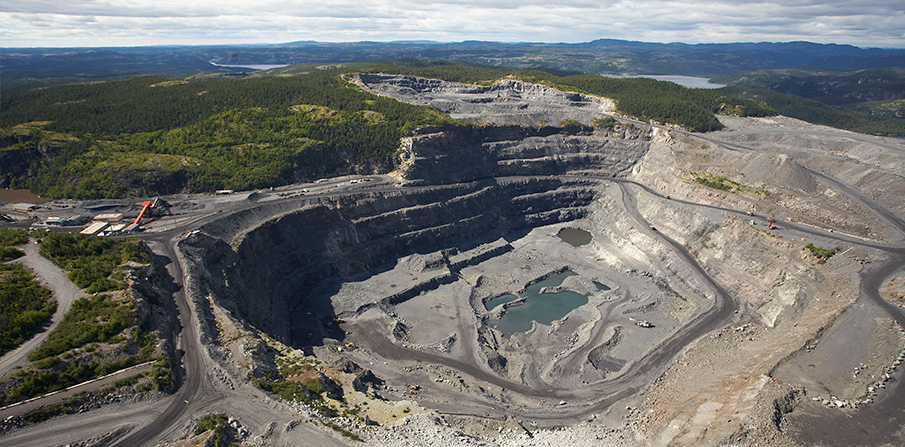
Above: Aerial view of the Lac Tio mine pit in Havre-Saint-Pierre, Quebec.
Industry Partner Spotlight
This story was provided by Rio Tinto, a CIM Industry Partner, and appears in the December 2025/January 2026 issue of CIM Magazine (view it in flip format here).

Ore sorting at Lac Tio
Rio Tinto demonstration project aims to improve economics of the operation and reduce GHG emissions from transportation
At Rio Tinto Iron & Titanium (RTIT) Quebec operations’ Lac Tio ilmenite mine, a $7.6 million demonstration project is putting leading-edge X-ray transmission (XRT) ore-sorting technology to the test. If successful, it would represent an opportunity for the company to significantly optimize Lac Tio’s operations, reduce greenhouse gas (GHG) emissions for rail and maritime transportation and processing at Sorel-Tracy, Quebec, unlock additional value from lower-grade material and extend the life of the mine.
This initiative builds on decades of pioneering advances at RTIT’s Quebec operations in Sorel-Tracy, including BlueSmelting—a low-carbon ilmenite reduction process—and the construction of North America’s first production facility for scandium oxide in 2022, which have positioned the company as a leader in mineral processing innovation and a key player in the critical minerals sector.
From waste to worth: the pilot study
Although Rio Tinto officially announced the XRT demonstration project—with a $2.5 million contribution from the Government of Quebec—in July 2025, the effort began four years earlier with a pilot study aimed at valorizing waste rock at Lac Tio, located 43 kilometres from Havre-Saint-Pierre.
Additionally, because ore grades vary significantly across the Lac Tio deposit, the company was also looking into ways to recover low-grade ores in sections of the deposit deemed uneconomic, which could lead to an updated mining plan and extend the life of the operation.
Between 2021 and 2022, Gianni Bartolacci, director of mining technology at RTIT’s Critical Minerals and Technology Centre in Sorel-Tracy, and his team set out to investigate if the XRT technology could provide the answer to both challenges. The pilot project tested XRT ore sorting on samples from both waste rock stockpiles and mined ore. The technology was able to remove up to 50 per cent of the waste rock, with an average reduction of 30 to 40 per cent.
These findings showed that XRT offered a chain of potential game-changing advantages, including reducing Lac Tio’s transportation costs and related GHG emissions. That’s because Lac Tio’s operation involves transporting partially crushed ore by rail from the mine to the port terminal, and then by boat to RTIT’s metallurgical and critical minerals complex at Sorel-Tracy for a second crushing and processing—a journey of almost 1,000 kilometres in total.
“By removing 30 to 40 per cent of the waste rock from lower-grade ore using the sorting system, we can improve the economics of the operation and reduce GHG emissions from transportation,” said Bartolacci.
The pilot study also revealed XRT could decrease the operation’s cutoff grade for material it categorizes as gangue. “This significantly increases the amount of ore that can be processed and valorized,” said Bartolacci. “For example, reducing the cutoff by 10 per cent could represent millions of tonnes of ore that can now be recovered. And if we can transport more ilmenite to Sorel-Tracy, that means we can recover more scandium [from it].”
By improving run-of-mine quality, the beneficiation process at Sorel-Tracy will be optimized to consume less natural gas in the roasting process. With a strong economic and environmental case for adding ore-sorting to Lac Tio, the company installed and commissioned a full-scale demonstration plant there in the fall of 2025.
Two-phased approach
In November, the team completed phase one of the project, processing only a small amount of material in preparation for the second phase, which will start in March 2026. The delay is because Lac Tio shuts down during the winter months, when severe weather impacts both the mining operation and the transportation of ore.
Phase two will validate that the process can successfully pre-concentrate the waste rock pile, valorize low-grade ore, and identify the optimal new target grade for the operation’s beneficiation process while consistently producing high-quality smelter feed that meets the operation’s furnace specifications.
Three different pre-concentrates will be generated and shipped separately to Sorel-Tracy to identify the optimal grade. Once that has been achieved, some 10,000 tonnes of material will be processed in the large-scale furnace to ensure the consistent production of titanium slag and high-quality pig iron.
Throughout the demonstration, the team will also gather data and insights for the integration of a commercial ore-sorting plant at Lac Tio. “By the end of 2026, we will have the results not just of the ore-sorting technology but also its impact on the entire chain,” said Bartolacci. “We will also have the data and lessons learned to know how to successfully integrate a commercial ore-sorting plant into the operation.”